What is AI Chat Commerce? The Future of AI Shopping

It is important to understand that Chatbot and AI Chat Commerce are not the same thing. A Chatbot is a conversational system that uses rule-based flows, AI, or a combination of both to interact with users. In contrast, AI Chat Commerce is an approach to selling that connects conversations with the customer journey, from product discovery and recommendations to purchase decisions. Therefore, a Chatbot can be one of the tools businesses use to enable Conversational Commerce, but AI Chat Commerce goes beyond simply answering customer questions.
In the future, AI will do more than just answer customer messages on brand websites. It is evolving from a Chatbot that answers questions into an AI Shopping Assistant that helps customers find the right products and make purchases through chat, turning conversations into another important sales channel for E-Commerce.
Google is developing Agentic Commerce, where AI can help people with different parts of the shopping process, from finding products to buying them. Google is also working on the Universal Commerce Protocol (UCP), which is designed to help AI connect with Commerce systems.
This can change the usual Customer Journey.
Instead of going through several steps to find the right product, a customer can simply tell AI what they need.
The customer does not always have to search for the product. AI can help find it for them.
That small change can make a big difference to the role of chat.
Chat has usually been used for customer questions, product information, or support after something goes wrong. Now, it can also become part of the shopping experience itself.
A customer might start by looking for a product, ask about its features, compare it with another option, check the price or promotion, and then continue with the order.
AI makes this more useful because it can understand what the customer is saying and look at the business’s own product information at the same time.
It is closer to the experience of talking with a salesperson who can listen to what the customer wants and suggest something that fits.
For businesses, this approach is known as AI Chat Commerce. It is a way of using conversation as part of the buying process, not just as a place for customer support.
What Is AI Chat Commerce? How Is It Different From a Chatbot?
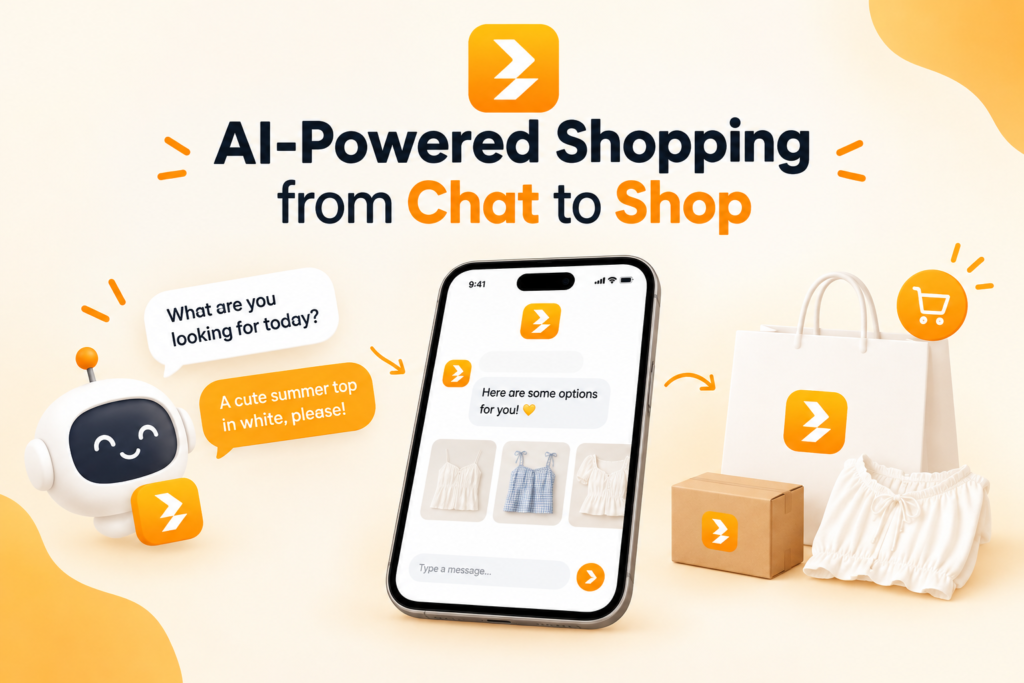
A Chatbot and AI Chat Commerce are related, but they are not exactly the same thing.
A traditional Chatbot often works with a Rule-based Flow. The business sets up questions, answers, buttons, and actions in advance. The Chatbot then follows those rules when talking to customers.
Some Chatbots can also use AI, so they are not always limited to fixed flows.
AI Chat Commerce is broader.
The idea is to bring conversation into different parts of the buying journey. A customer can use chat to find a product, explain what they need, get recommendations, make a decision, place an order, and ask for help afterward.
For this to work well, the system needs access to the right business information.
That could be product details, prices, stock, promotions, order information, and customer data. Depending on the business, it may also need to connect with other systems used by the Sales or Customer Service team.
So the difference is quite simple. A Chatbot is a tool for talking with customers. AI Chat Commerce is a way of using that conversation as part of the buying process.
| Comparison | Chatbot | AI Chat Commerce |
|---|---|---|
| Main Objective | A system that automatically answers customer questions through chat channels using rule-based flows, AI, or a combination of both. | An AI-powered conversational system that connects the customer journey, from product discovery to purchase completion, through chat. |
| How It Works | Responds according to predefined flows or uses AI to understand customer questions and generate responses. | Uses AI to understand customer needs and connect conversations with different stages of the purchasing process. |
| Data Integration | Can integrate with FAQs, product information, and other systems, depending on the available features. | Connects product information, pricing, inventory, and ordering systems to support the end-to-end sales process. |
| Usage Limitations | May have limitations in handling complex questions or providing context-aware product recommendations, depending on the system's capabilities. | Requires accurate product data and well-integrated systems to ensure reliable recommendations and a seamless purchasing experience. |
| Example Platforms | Chatcone, Oho.chat, Pancake | Saifa AI, Zaapi, ZWIZ.AI |
How Does AI Chat Commerce Work?
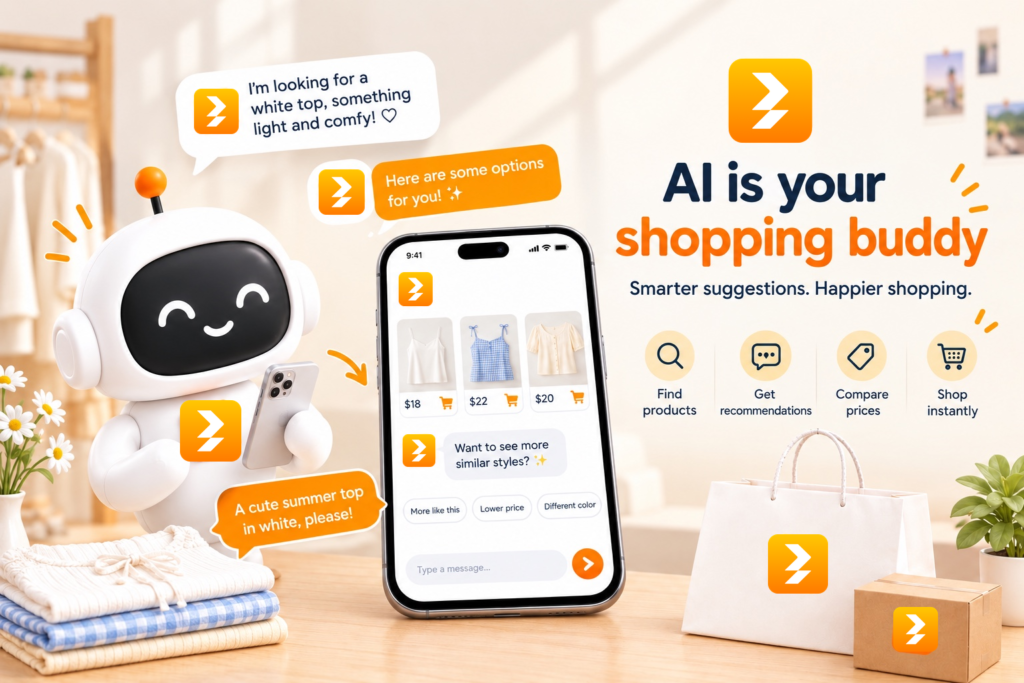
There is no single setup that every business has to follow.
But if we look at the customer journey, the process can be broken down into five common stages: Discover, Understand, Recommend, Convert, and Retain.
1. Discover — Find the Right Product
The first step is helping customers find products without making them do all the searching themselves.
With a traditional E-Commerce website, customers normally start with a product name, category, or Keyword. They may then use Filters to narrow down the results.
That works when they already know what they want.
But not every customer shops that way.
Someone might know the problem they want to solve but have no idea which product is suitable. They might also have a few requirements in mind but not know the right product terms to search for.
This is where a conversation can make things easier.
Instead of trying to guess the right Keyword, customers can describe what they need in their own words. AI can then look at that information together with the company’s product data.
The data could include Product Catalog, Product Description, price, product features, categories, promotions, and stock.
The customer does not have to understand how the store has organized its products. They just need to explain what they are looking for.
AI can then connect that need with the products available in the system.
This turns chat into another way for customers to discover products.
2. Understand — Figure Out What the Customer Really Needs
Finding a product is only the beginning.
The next question is whether that product actually fits the customer.
For example, two customers might be looking for the same type of product but have completely different needs. One may care most about price. Another may care about a specific feature or how the product will be used.
Those details usually do not appear in a single search Keyword.
During a conversation, however, customers can give more information as they go.
AI can look at the whole conversation and pick up on things such as Customer Intent and Context. It can use what the customer said earlier instead of treating every message as a completely new question.
This makes the interaction feel less like a search box and more like a conversation.
There is also another benefit for the business.
Customer conversations contain useful information. They can show which products people are interested in, what they are comparing, what they are unsure about, and what is stopping them from buying.
Over time, this can become useful Business Data for Sales, Marketing, and Customer Service teams.
3. Recommend — Help Customers Choose
Once the system has a better idea of what the customer wants, it can start recommending products.
This does not have to mean showing a long list of products.
AI can take different pieces of information into account, including the customer’s needs, product features, price, stock, promotions, and other information from the Product Catalog.
It can also explain why a product may fit the customer’s needs.
That part matters because customers often have enough choices already. The problem is not always finding more products. Sometimes they just need help making sense of the options.
A good recommendation can bring the useful information together in one place.
From the business side, this is where product information becomes more useful. Instead of simply storing product details, the business can use that information to support a customer’s decision.
In this way, the conversation starts to work more like an AI Personal Shopper.
It can help the customer move from looking at products to seriously considering one.
4. Convert — Move From Interest to Purchase
Eventually, the customer has to decide whether to buy.
This is where the connection between AI and the business’s systems becomes important.
If AI can only answer questions, the customer may still need to leave the chat, open a website, check the product again, and start the ordering process somewhere else.
That creates another step in the journey.
With the right integrations, the conversation can connect with systems such as Product Catalog, Inventory, Order Management, Payment, and Shipping.
The exact setup will depend on the business. Not every system needs to be connected from day one.
What matters is that the conversation can connect to the parts of the buying process that customers actually need.
This is also why Workflow matters in AI Chat Commerce.
AI may understand what the customer wants, but it still needs the right system connections to turn that request into an action.
For example, product information can help AI answer a question, while inventory data can tell it whether the product is available. Order data can then support the next step once the customer decides to buy.
The conversation becomes a bridge between Customer Intent and Business Action.
5. Retain — Keep the Conversation Going After the Sale
The customer journey does not stop after payment.
There may still be questions about delivery, order status, product usage, returns, exchanges, or other issues.
This is where AI Chat Commerce connects with Customer Service and After-Sales Service.
If the system can access customer and order information, AI can use that information when helping the customer.
For example, instead of asking for the same order details again, the system may already have the information it needs to continue the conversation.
These post-purchase chats can also tell the business a lot.
They can show common customer problems, questions about products, delivery issues, or products that customers keep asking about.
That information can be useful when improving products, Sales Process, and Customer Experience.
So AI Chat Commerce is not only about getting the first purchase.The conversation can continue before the sale, during the sale, and after the sale.
How to Build AI Chat Commerce With Saifa AI
AI Chat Commerce needs more than a Chatbot.
The AI needs to understand the business. Product information needs to be available. And when the business wants AI to take action, the right systems and Workflow need to be connected as well.
This is where Saifa AI can be used.
Saifa AI combines Company AI and Customer Service AI, allowing businesses to connect their own information with AI.
Businesses can add information from sources such as Website, Product Catalog, FAQ, SOP, PDF, Word, Excel, CSV, and internal documents.
The AI can use this information when answering customer questions and helping customers find the information they need.
Saifa AI can also connect with customer channels such as LINE OA, Facebook Messenger, Instagram, and Website Chat.
This gives businesses a way to bring AI into the channels where customers are already asking questions.
When a question needs a person to handle it, the chat can also be passed to an admin.
For businesses exploring AI Chat Commerce, the important point is not simply having AI inside a chat box.
The bigger question is whether the AI can work with the Company Data, Product Information, Customer Data, and Workflow that sit behind the conversation.
The Future of AI Chat Commerce
The way people shop online is changing.
For years, the website was the main place where customers searched for products, read information, compared options, and bought something.
AI is adding another way to do these things.
Instead of starting with a search box, customers can start with a conversation.
They can explain what they need in their own words. AI can then help them find relevant products, understand the options, answer questions, and continue through the buying process.
This is what makes AI Chat Commerce different from simply adding a Chatbot to a website.
The focus is no longer only on answering the customer’s question. It is about connecting the conversation with the rest of the business.
That can mean AI + Business Data + Product Information + Workflow working together.
When all of these are connected, chat can become part of the Sales and Customer Service journey rather than just another support channel.
For businesses, this opens up a different way to think about E-Commerce. The online store does not have to be only a place where customers browse products. The conversation itself can become part of the shopping experience.
If your business wants to move beyond using AI just to answer customer chats and start connecting AI with Customers, Business Data, and Workflow, learn more about Saifa AI
👉🏻Learn more about Saifa AI for Customer Service: https://saifa.ai/th/ai-customer-service/