Why Can AI Answer General Questions but Not Company-Specific Questions?
Have you ever wondered why AI can answer general questions so well, but struggles with questions about a specific company?
One simple reason is Private Company Data. A company’s internal information is usually not available on the internet. It is also not part of the general information that AI already knows.
AI is now being used by businesses in many different ways. Teams use it to answer questions, create content, analyse information, and support daily work. But using AI does not always mean getting useful business results.
The Global Enterprise AI Report 2026 from Publicis Sapient surveyed 1,550 executives and AI decision-makers from organizations around the world. The report found that 73% said their organizations regularly use AI or use it in several parts of the business. At the same time, only 10% said AI has become an important part of their business operations, while 42% said their organizations are not yet ready to get the full value from AI.
There is a clear difference between using AI and using AI with the business.
An AI tool may be able to write an email or explain a topic. But that does not mean it knows a company’s products, prices, policies, customers, or internal processes.
In other words, AI can be good at answering questions without actually knowing the business.
Why Doesn't AI Understand Our Business?
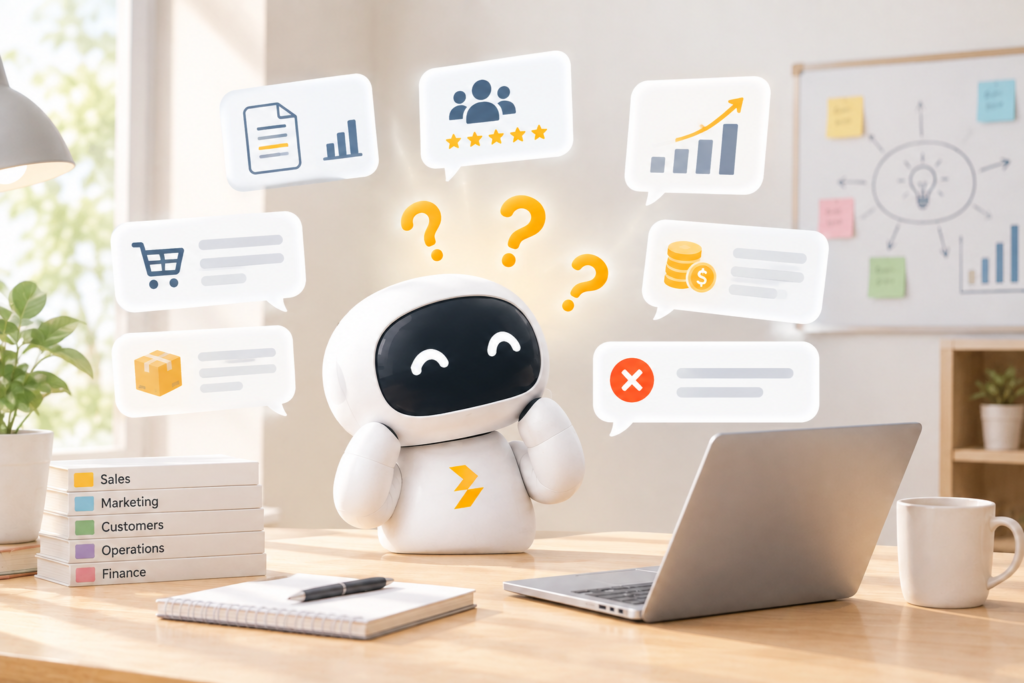
AI can process a lot of information very quickly. It can also answer questions about many different topics. But that does not mean it knows how a particular company works.
Knowing about an industry is different from knowing a company.
For example, AI may understand how online shopping works in general. But it will not automatically know a specific store’s latest prices, return policy, product stock, or internal process.
This information is part of the company’s Business Knowledge.
Every business has its own way of working. Even two companies in the same industry may have different products, rules, customer groups, and workflows. So when a business wants AI to answer company-related questions, general knowledge is not enough.
AI needs access to the right data, context, and systems.
That is what allows AI to move beyond general answers and work with information that is actually used inside the business.
Comparison between General AI and Company AI
| Comparison | General AI | Company AI |
|---|---|---|
| Main Purpose | Helps answer questions and perform a wide range of general tasks | Supports business tasks using company-specific data and knowledge |
| Data Sources | Uses general knowledge learned during training, along with additional information provided by users or connected systems | Combines general AI knowledge with company data and knowledge that have been uploaded or connected |
| Answering Questions | May be unable to answer or may provide inaccurate answers when relevant information is missing | Can use available company information to help answer questions accurately |
| Use Cases | Writing content, summarizing documents, brainstorming, and analyzing general information | Answering product questions, finding company policies, supporting customer service teams, and helping employees access internal knowledge |
| Examples of AI | ChatGPT, Gemini, and Claude when used as general-purpose AI tools | Saifa AI, which uses company knowledge to support AI-powered business tasks |
Why Can't General AI Answer Business Questions?

1. AI Does Not Have Company-Specific Data
The first problem is quite simple: general AI does not have your company’s data.
AI may know a lot about your industry, but it does not automatically know your product list, prices, promotions, company policies, customer information, or internal documents.
For example, AI may know what a return policy is. But it does not know your store’s return policy unless you give it that information.
Every company has its own set of information. This information becomes part of the company’s Business Knowledge.
Without access to that data, AI has to rely on what it already knows. The answer may sound correct, but it may not match the way your company actually works.
2. Business Information Is Different for Every Company
There is another problem. The answer to a business question can be different from one company to another.
Two stores may sell similar products but have different prices, promotions, payment methods, shipping rules, or return policies.
This is why general information cannot always be used to answer company questions.
A business needs AI to work with its own information, rather than simply giving an answer that sounds reasonable.
Business Knowledge gives AI access to information that belongs to the company. It helps AI know which information to use when answering a question.
3. AI Does Not Know the Business Context
Having the data is one thing. Knowing when and how to use it is another.
Business information can have different meanings depending on the situation.
A price may be different for different sales channels. A promotion may apply only to certain products. A customer may have a different process depending on the type of order.
Without the right business context, AI may have the information but still use it in the wrong situation.
This is why AI needs more than a collection of company documents. It needs to understand how the information fits into the way the business works.
4. Business Data Changes All the Time
Company information does not stay the same for long.
Prices change. New products are added. Promotions end. Policies are updated. Internal processes can also change.
So, even if AI has the right information today, that information may become outdated later.
This is especially important for businesses that use AI to answer customer questions. If AI uses an old price or an expired promotion, the customer may receive the wrong information.
Businesses therefore need to keep their Business Knowledge updated. AI needs access to the latest company information when it is used for daily work.
5. AI Does Not Automatically Know the Company's Data and Systems
Company information is often spread across many different tools.
Product data may be in one system. Orders may be in another. Customer chats may be handled through different channels. Stock information may be stored somewhere else.
AI does not automatically have access to all of these systems.
This can become a problem when businesses want AI to do more than answer general questions.
For example, if a customer asks about an order, AI needs access to the order information to give a useful answer. Knowing general information about online shopping is not enough.
So, using AI for business is not only about choosing a good AI Model. It is also about connecting AI with the data and systems the business already uses.
6. Using Prompts Alone Does Not Make AI Understand the Business
A detailed Prompt can tell AI what role it should play and how it should respond.
For example, a business can tell AI to act as a Customer Service assistant and answer customers in a friendly and short way.
But the Prompt does not tell AI what the company’s actual information is.
It does not automatically give AI the latest product prices, company policies, order information, or internal documents.
This is why a Prompt tells AI what to do, while Business Knowledge tells AI what information to use.
Both are useful, but they do different things.
A good Prompt can guide AI’s behaviour. Business Knowledge gives AI the information it needs to answer based on the company.
How to Make AI Understand Your Company: 5 Steps to Build AI That Can Answer Business Questions
Making AI understand a company does not mean building a new AI Model from zero.
The bigger task is giving AI access to the information it needs and making sure it knows how that information should be used.
Here are 5 steps businesses can start with.
1. Collect the Company Data AI Needs
Start with the information AI will need in its daily work.
This could include product information, services, prices, promotions, customer service details, company policies, and internal processes.
The information can come from different sources, such as Website, PDF, Word, Excel, CSV, FAQ, SOP, and Company Policy.
The more complete the information is, the easier it is for AI to find the right answer.
It is also important to keep the information updated as the business changes.
2. Connect Company Data to AI
Once the information is ready, it needs to be connected to AI.
This allows AI to look for the right company information when someone asks a question.
For example, if a customer asks, “How much does this product cost?”, AI can check the company’s Product Catalog or Price List before answering.
Instead of guessing from general knowledge, AI can use the company’s own information.
3. Define How AI Should Respond
Company data tells AI what information it has. But businesses also need to decide how AI should use that information.
For example, a company may want AI to:
- Answer in a short and friendly way
- Use a specific brand tone
- Only provide information from approved Company Data
- Ask for more information when needed
- Hand the chat to an admin when AI cannot answer
These rules help AI respond in a way that fits the business.
4. Connect AI to the Company's Workflow
AI does not have to stop at answering questions.
Businesses can connect AI with the systems and Workflow they already use, such as CRM, Order, Stock, and customer chat channels.
For example, when a customer asks about an order, AI can check the connected order system and use that information in its reply.
This gives AI a more useful role in daily business work.
5. Keep Company Data Up to Date
Business information changes regularly.
A product may get a new price. A promotion may end. A new product may be added. A company policy may also change.
AI needs to receive these updates if businesses want it to keep giving useful answers.
Keeping Company Data updated should therefore be part of the regular AI workflow, not something done only when AI is first set up.
How Does Saifa AI Help General AI Work with Business Context?
Although General AI tools such as ChatGPT, Gemini, and Claude can answer general questions and help with many tasks, they may struggle to answer questions about company-specific information, such as the latest product prices, return policies, internal rules, or work procedures, if they do not have enough information about the business.
This does not mean General AI is not capable. The problem is that its general knowledge does not cover the specific information of every company. Businesses need a way to connect their data, knowledge, and business context to AI so it can answer questions related to their actual operations.
Saifa AI is a Company AI that helps businesses use their company knowledge with AI. Businesses can add information sources such as websites, PDF, Word, and Excel files, FAQs, SOPs, and Product Catalogs. This allows AI to use company information when answering questions instead of relying only on general knowledge that may not match the business’s actual information.
However, giving AI access to company information is not enough. Businesses also need to organize their knowledge clearly and keep it up to date. If product prices are inconsistent or old and new policies are mixed together, AI may still use incorrect information when answering questions. Preparing Business Data and Business Knowledge is therefore important to reduce the risk of incorrect answers, while Business Context helps AI understand which information to use for each question and situation.
Ultimately, helping AI answer business questions more effectively is not just about choosing a more powerful AI model. Businesses also need to ensure that AI can access accurate information, understand company knowledge, and use that information appropriately. This helps AI work in a way that better meets the real needs of the business.
Build AI for Your Business Without Starting From Zero
Businesses do not need to build a new AI Model from scratch just to make AI understand their company.
What matters is whether AI can access the right Company Data, find the information it needs, and use that information in the right context.
This is where Saifa AI can help.
Businesses can use Website, PDF, Word, Excel, FAQ, SOP, and company documents as data sources for AI. Saifa AI can also connect with customer chat channels and business workflows.
Instead of using AI only for general questions, businesses can give AI access to the information they actually use every day.
The goal is simple: give AI the right company information so it can answer questions based on the business, not just general knowledge.
👉 Learn how to build AI for your business with Saifa AI: https://app.saifa.ai/