What is Business Knowledge? Why Is It Important for AI in Organizations
If you want AI to work well with your business, it needs to know more than general information. It needs to know how your company works, what information you use, and what rules your teams follow.
This is where Business Knowledge comes in.
AI can understand language, read documents, analyse data, and create answers in seconds. But without company-specific information, it may not know which answer is right for your business.
For example, AI may know how an online store works. But it will not know your product prices, return policy, sales process, or customer service rules unless you give it that information.
So, when businesses look at AI, the AI Model is only part of the picture. The information that AI can access and use is just as important.
What is Business Knowledge?
Business Knowledge is the information a company uses to run its business. It gives AI the information it needs to understand the company better.
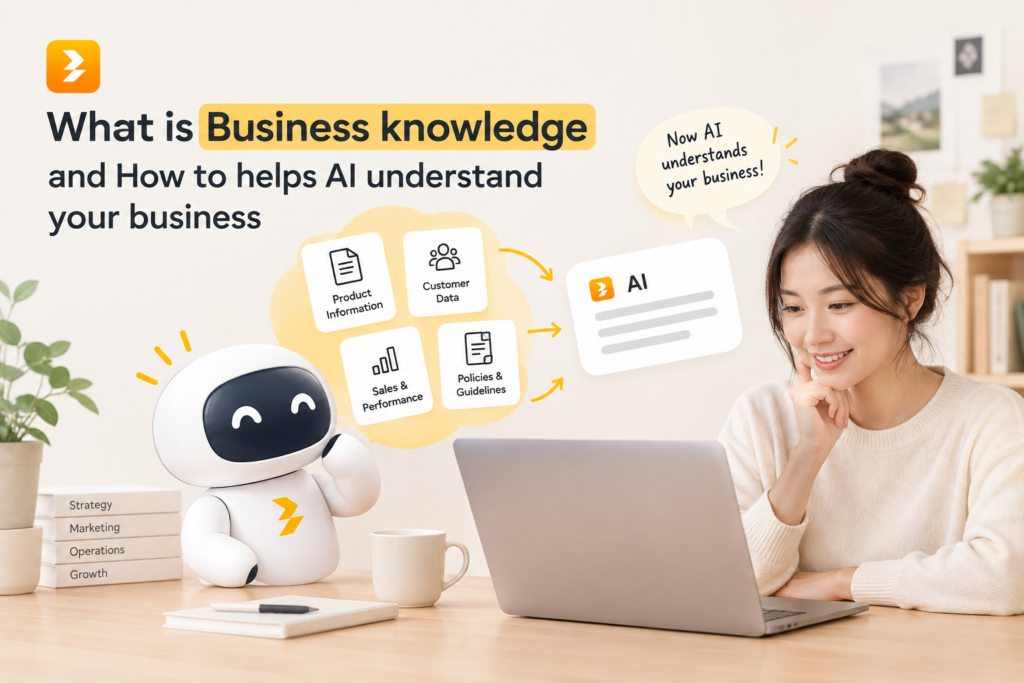
This can include simple things like product details, prices, and customer information. But it can also cover company rules, policies, SOPs, and the steps teams follow when doing their work.
The information may be stored in many places. Some of it may be on a Website, PDF, Word, Excel, CSV, FAQ, SOP, or Product Catalog. Other information may sit inside systems such as CRM, Order, and Stock.
When these sources are connected to AI, the AI can use them when answering questions or helping with tasks.
In simple terms, Business Knowledge gives AI the information it needs to understand your company, rather than relying only on general knowledge from the AI Model.
The Difference Between Business Data, Business Knowledge, and Business Context
To help AI understand a business, it is not enough to simply give it a large amount of data. AI also needs to understand what the data means and how to use it in different situations. These can be divided into three important parts: Data, Knowledge, and Context.
1. Business Data: The Basic Information a Business Already Has
Business Data is the basic information a business collects, such as product details, prices, stock levels, sales figures, order history, and customer inquiries. This data gives AI the information it needs to perform different tasks.
For example, an online store has information showing that Shirt A costs 590 baht, comes in three colors, and has 20 items left in stock. This is Business Data because it provides facts about the product. However, it does not explain how AI should use this information to answer customer questions or recommend products.
2. Business Knowledge: Knowledge Built from Data
Business Knowledge is information that has been organized, explained, and connected to a company’s rules and policies. It helps AI answer questions, explain details, and perform tasks more accurately.
For example, a store has information about the type of fabric used for each product, available sizes, suitable uses, and return or exchange policies. When this information is organized into categories and connected, AI can use this knowledge to provide customers with more complete and accurate answers.
3. Business Context: Understanding the Business Situation
Business Context means helping AI understand what a business does, what its goals are, and how to use available information in different situations. It is not just about knowing business information. AI also needs to understand the situation, goals, and conditions that affect how it should respond or perform a task.
For example, a customer wants a shirt for work that is comfortable and not too hot. AI needs to understand the customer’s needs, preferred style, and budget to recommend products that best match their requirements.
What Does Business Knowledge Include?
There is no single format for Business Knowledge. It depends on what the business does and what it wants AI to handle.
| Type | Examples |
|---|---|
| Product Knowledge | Product details, prices, features, Stock |
| Customer Knowledge | Customer Profile, purchase history, customer needs |
| Company Policy | Company policies, return conditions |
| SOP | Work steps for each team |
| Sales Knowledge | Sales Process, Promotion, Pricing |
| Customer Service Knowledge | FAQ, problem solving, Escalation |
| Marketing Knowledge | Brand Guideline, Campaign, Content |
| Operational Knowledge | Workflow, approval steps, daily operations |
| Historical Data | Order, Chat, Case, past records |
| Business Rules | Rules and conditions AI needs to follow |
A company may have all of this information in different places. Website, PDF, Word, Excel, CSV, FAQ, SOP, Database, and business systems can all be useful sources.
The important part is choosing the information that AI actually needs for each use case.
6 Ways Business Knowledge Helps AI Understand Your Business

1. AI Gets to Know Your Business
General AI already knows a lot. But it does not know your company just because it knows your industry.
Think about two online stores selling similar products. They might have completely different prices, promotions, return policies, and ways of dealing with customers.
Your company has its own information too.
Adding this information through Business Knowledge gives AI a clearer picture of what your company does. It can learn about your products, services, customers, and internal processes.
Without it, AI has to fall back on general information.
That is why the AI Model and Business Knowledge play different roles. The model handles the language and reasoning, while Business Knowledge gives it information about your company and the way your business works.
2. AI Can Use the Company's Actual Information
There is a difference between an answer that is generally correct and an answer that is correct for your company.
Take product pricing as an example. AI may know how pricing works in general, but it does not know your latest price unless that information is available to it.
The same applies to promotions, shipping rules, return conditions, service policies, and other company information.
With Business Knowledge, AI can refer to the information provided by the company when it answers a question.
This is especially useful for Customer Service, Sales, and internal teams. They often need specific information, not just something that sounds right.
3. AI Understands the Situation Behind the Question
Sometimes the words in a question are not enough.
A customer asking about a product may be asking because they want to compare two products. A Sales team member may be asking about the same product for a different reason.
The answer may depend on what is happening around the question.
This is what business context is about.
Business Knowledge can give AI more than a document or a list of facts. It can include the rules, processes, customer information, and other details connected to the situation.
With more context, AI has a better chance of giving an answer that fits the actual situation instead of giving the same general answer every time.
4. AI Knows More Than Just the Data
Businesses do not run on data alone.
There are also rules about what teams should do with that data.
For example, a Product Catalog may tell AI what products are available. But an SOP may explain how an order should be checked. A Policy may explain when a discount can be approved. A Workflow may show which team should handle the next step.
All of these can be part of Business Knowledge.
When AI has access to both information and work processes, it can understand the connection between what it needs to know and what needs to happen next.
This becomes important when a business wants AI to do more than answer questions and start helping with actual tasks.
5. AI Can Communicate in Your Brand's Style
Knowing the company is not only about facts.
AI also needs to know how the brand talks to people.
One company may prefer formal language. Another may use a friendly and casual tone. Some brands want their messages to be short and simple, while others may have a more specific style.
This can be included in Business Knowledge, such as Brand Voice, Tone of Voice, words to use, and communication guidelines.
It is useful when AI talks directly with customers or helps the team create content.
After all, getting the information right is only part of the job. The message should also feel like it came from your brand.
6. AI Can Better Understand Your Customers
Product information tells AI what a company sells. But it does not always tell AI what customers need.
Every business has different types of customers. They may ask different questions, have different problems, and need different kinds of help.
Business Knowledge can include customer information, target groups, common questions, past issues, and other service-related data.
This gives AI more Customer Context when it works with customers.
For example, AI can look at customer information together with product or service information before answering. This can also make it easier for AI to support Customer Service and Sales teams.
Instead of treating every customer chat as a separate question, AI can have more context about what the customer is asking and why.
How to Start Building Business Knowledge for AI
Building Business Knowledge does not mean putting every file your company has into an AI system.
The first step is to work out what information AI actually needs.
Start with the information your teams use every day. This could be product information, customer data, FAQ, SOP, Policy, Product Catalog, Pricing, Workflow, or information from internal systems.
Then take a look at the quality of that information.
Companies often have several versions of the same document. Some files may be old. Some information may only be known by one team.
If AI gets all of this without any clear structure, it may not know which information to use.
That is why Data Quality matters.
The information used by AI should be accurate, complete, and up to date. Access should also be controlled, especially when the data contains internal or customer information.
What Do You Need to Prepare for AI?
The information you need will depend on the job you want AI to do.
- AI for Customer Service: Product Knowledge, FAQ, Policy, Promotion, Shipping Information, and rules for handing a chat to an admin.
- AI for Sales: Customer Data, Product Catalog, Pricing, Sales Playbook, Proposal, and CRM data.
- AI for Operations: SOP, Workflow, Approval Rules, and information from internal systems.
You do not have to prepare everything at once. It can start with the information needed for one specific use case and grow from there.
Learn how to use Business Knowledge with Saifa AI
For businesses that want to use company information with AI, Saifa AI is designed around Company AI and Customer Service AI.
Instead of using AI only as a general Chatbot, businesses can give Saifa AI access to their own information.
Sources can include Website, PDF, Word, Excel, CSV, FAQ, SOP, Product Catalog, and internal company documents.
Saifa AI can also connect with Customer Service channels and business systems. This means the information can be used for tasks such as answering customers, finding company information, handing a chat to an admin, and working with team Workflow.
👉🏻 Learn more about Saifa AI: https://saifa.ai/th/ai-customer-service/
Why Does Business Knowledge Matter for AI?
AI is moving beyond simple Chat Assistance. Businesses are also looking at AI Agents and Agentic Workflow that can handle tasks and work across different systems.
As AI takes on more work, company information becomes more important.
An AI that can answer general questions is useful. But an AI that works inside a business needs to know more. It needs access to the company’s information, rules, and ways of working.
That is where Business Knowledge makes a difference.
It gives AI the information it needs to work with a specific company instead of treating every business the same.
The goal is not simply to add AI to a business. It is to give AI enough information to understand the company, use its data, and work with the systems and Workflow already in place.
Saifa AI brings together Company AI and Customer Service AI to help businesses use their own information with AI.
Companies can use Business Knowledge for customer support, internal information search, team assistance, and workflows connected to daily business operations.
If you want to use AI with your company’s data and workflows, explore Saifa AI now app.saifa.ai