5 Ways AI Can Help SMEs Improve Business Management
McKinsey – The State of AI report reveals that organizations around the world are moving past AI experimentation to leverage AI to drive measurable business outcomes, whether that’s improving operational efficiency, reducing costs or creating new revenue opportunities.
AI is no longer about doing things faster for SME businesses. This is about changing the way businesses operate from how they plan and analyze data, to how they make decisions and deliver better customer experiences.
This article looks at how AI for SME can help businesses improve management processes systematically. It provides real-world examples and recommendations for how to begin using AI in business processes.
How AI Can Assist with Business Management?

People might often think of AI as text generation, image creation or chatbots answering simple questions. But today, artificial intelligence can do so much more to help business management, including improving internal operations, analyzing data, and helping business leaders make strategic decisions.
AI is a powerful helper for SMEs with limited resources, helping teams achieve more without a significant increase in workforce costs.
AI is not coming to replace human agents. Instead, it allows employees to work faster, make better decisions and maximize existing resources. For many businesses, AI has become an indispensable tool, particularly for those businesses where teams often have to wear multiple hats to improve overall business management and operational efficiency.
Benefits of Using AI to Improve Business Management
| How AI Helps Businesses | Benefits of Using AI | Business Advantages |
|---|---|---|
| Increase Employee Productivity | Reduce time spent on repetitive tasks such as summarizing information, creating documents, searching for data, and answering common questions | Employees can focus on higher-value tasks and accomplish more without significantly increasing workforce size |
| Reduce Operational Costs | Automate certain workflows, reduce manual work, and minimize human errors | Businesses can manage resources more efficiently and improve profitability by reducing unnecessary costs |
| Faster Data Analysis | Process large amounts of data, including sales performance, customer behavior, and market trends, in a shorter time | Business leaders can make data-driven decisions and reduce risks from assumptions or guesswork |
| Gain Deeper Customer Understanding | Analyze customer behavior, purchase history, and customer conversations to identify real needs and preferences | Businesses can offer more relevant products, services, and promotions, increasing sales opportunities |
| Improve Customer Service | AI Chatbots and AI Assistants can provide 24/7 support and handle repetitive customer inquiries | Customers receive faster responses, while teams can focus on more complex cases that require human expertise |
| Enhance Marketing & Sales Performance | Support content creation, audience analysis, lead qualification, and customer journey tracking | Marketing and Sales teams can work more accurately, optimize budgets, and improve conversion rates |
| Manage Organizational Knowledge | Centralize company knowledge such as SOPs, manuals, product information, and internal documents for easier access | Reduce dependency on individual knowledge and help employees quickly find the information they need |
| Operate 24/7 | Handle continuous tasks such as customer support, information retrieval, and data monitoring without time limitations | Businesses can provide always-on service and capture more revenue opportunities |
| Scale Business More Easily | Support increasing workloads without requiring resources to grow at the same rate | SMEs can expand faster and compete more effectively with larger businesses |
| Create Competitive Advantage | Enable businesses to adapt faster, analyze markets, and respond to customer needs more effectively | Companies can differentiate themselves from competitors and build a stronger foundation for long-term growth |
👉 Related article: What Is an AI Agent and Which Jobs Will It Replace?
How to Implement AI Successfully for SME Business Management in 5 ways
1. Discover Business Challenges AI is able to Solve
SMEs should not start by choosing an AI tool before investing or adopting AI. Rather, companies need to have a clear understanding of their challenges. AI is just a tool to solve a problem and if you don’t know the actual pain points, it is difficult to select the right AI tool and get a good ROI.
Many businesses jump into AI because it’s “trendy” or they don’t want to be left behind competitors. But they often don’t get clear results because they start with selecting AI tools rather than pain points for the business.
First, businesses should identify areas such as:
- Time-consuming tasks
- Business process issues
- Daily repetitive tasks employees perform
- Information that is too slow to collect or locate
- Problems whose solution would have the big positive impact
Then, after businesses identify their pain points, they can choose where to focus first on AI. This gives you a clear goal, measurable results and a better chance of faster ROI than if you try to implement AI without a clear sense of direction.
2. Prepare Business Data Before Using AI
Another common challenge for SMEs before adopting AI is that their internal data is not ready. Although there are many AI tools available today, AI cannot deliver high-quality results if business data is scattered across different systems, outdated, or poorly organized.
Many businesses store information across multiple Excel files, Google Drive documents, LINE conversations, emails, or individual employees’ knowledge. AI could also use out-of-date or incomplete data for searching or analyzing information, leading to inaccurate answers.
The quality of data is critical to the quality of AI. This principle is sometimes expressed as “Garbage In, Garbage Out (GIGO)” which means that bad quality input data results in unreliable output.
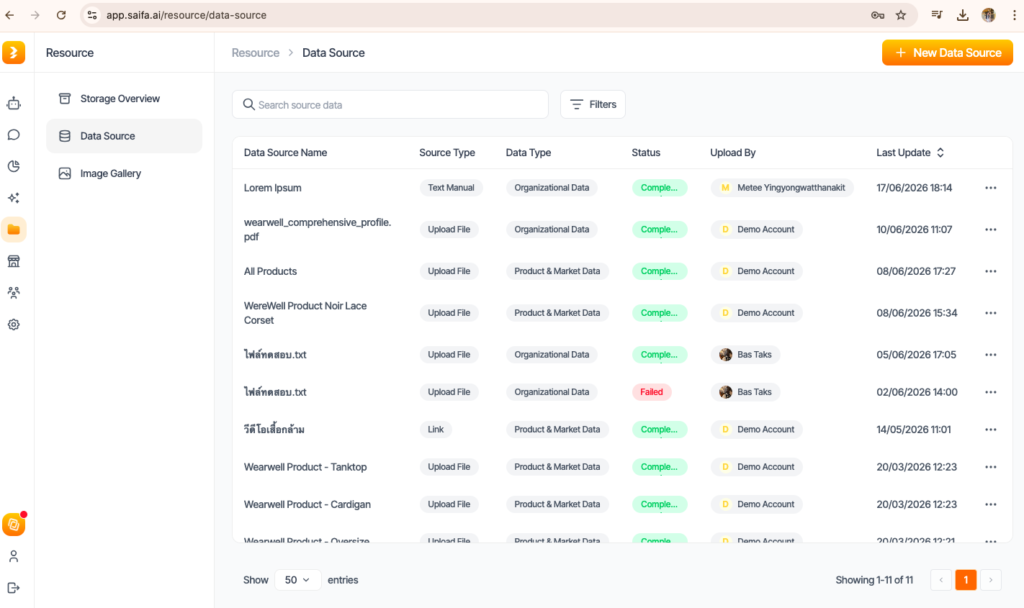
Businesses need to start by consolidating critical information into a central system. This can include customer data, product information, Standard Operating Procedures (SOPs), operational reports, internal knowledge bases and FAQs.
With data that is structured and accessible, artificial intelligence is able to do more than answer questions, and can become a powerful assistant for analyzing information, generating reports and supporting better business decisions.
3. Choose AI Tools That Match Business Goals
Once companies understand the challenges and get their data ready, the next step is to choose the right AI tools with specific business objectives. Not all AI solutions are created to solve the same problems.
So, selection AI should start with a clear definition of what the business wants AI to do. There are different AI solutions for different purposes:
- Companies might need AI automation tools to cut down on repetitive workloads.
- Businesses should look for AI that is good at analyzing data to help them make decisions.
- Integrated with company data and customized to meet business needs, AI that understands products, services, and internal processes is possible.
Today, there are hundreds of AI platforms to choose from content creation and data analysis tools to customer service AI and Company AI that learns business intelligence and can support organization-wide operations.
Selecting AI just because it is trending or features can lead to a loss of time, budget, and resources with no meaningful business outcomes.
4. Start with AI Use Cases That Deliver Quick Results
Once the right AI solution has been selected many companies ask “Where do we get started with AI first?” The answer is not to transform the whole organization at once, but to begin by creating use cases that can provide fast and measurable results.
It’s a common mistake to try to implement AI in many places at once and expecting immediate results. This often adds to the workload of teams, complicates things and makes it hard to measure if AI investment is really creating value.
Many successful organizations start with Quick Wins. Quick Wins are small projects that can deliver results fast, such as automated summary reports, Internal document research, writing emails or generating contents. If a company can see the improvements clearly such as reduced working time, higher work quality or increased team efficiency, then AI may be extended to marketing, data analysis, business planning and customer management.
5. Measure Results and Continuously Improve AI Usage
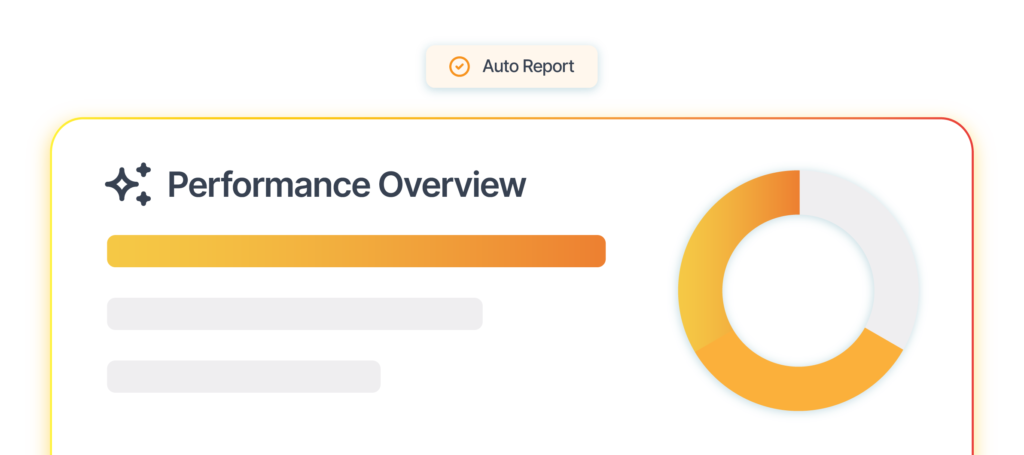
After adopting AI, measure results and improve deployment. It’s not just about setting up a tool or a system in AI. Instead, the business team should learn, adapt and improve their use of AI over time. Many SMEs fail to use AI, because they do not set clear goals and performance indicators upfront. For AI to make your business more efficient, you need to set measurable goals.
Systematic measurement allows businesses to see where and how AI is creating value and where the work is still to be done. Instead of seeing AI as a technology expense, companies can treat AI as a strategic investment to allow for long-term growth and competitiveness.
Before adopting AI, businesses should define relevant KPIs, such as:
- Reducing workload: Measure hours saved or reductions in repetitive tasks.
- Improving customer service: Measure response time, customer satisfaction, or the number of cases handled daily.
- Increasing operational efficiency: Measure productivity improvements and process improvements.
3 Steps Start Using Saifa AI for SME Business Management
Step 1: Setting AI for Customer Support 24/7
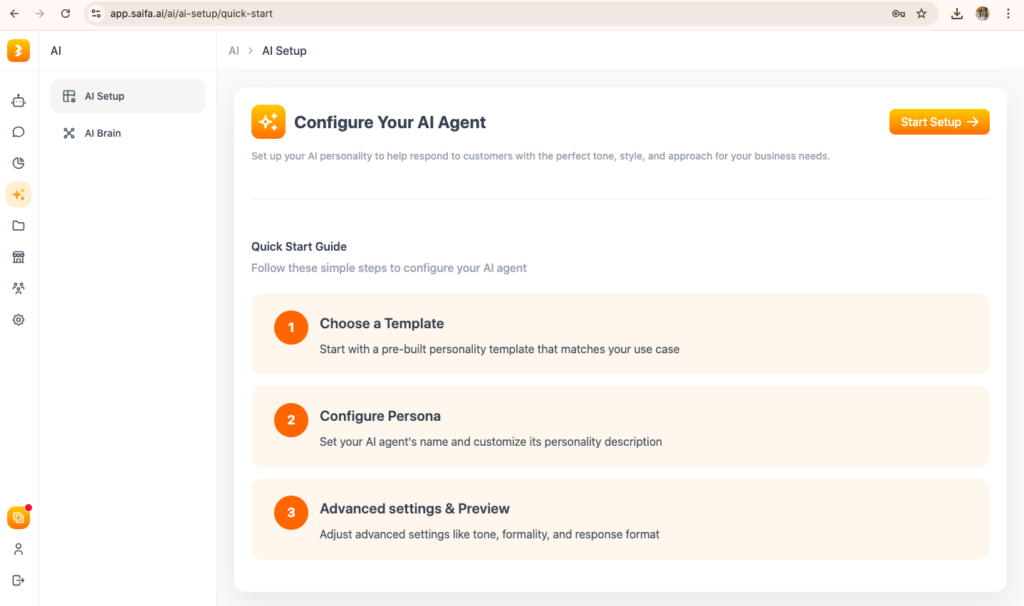
Saifa AI is able to be used as an AI-powered customer service assistant for businesses to answer customer inquiries through various channels including LINE OA, Facebook, Instagram and Web Chat. It answers repetitive questions such as product information, pricing, promotions, order status and service information.
When a complex case comes up, Saifa AI can hand it over to an admin or Sales team through Human Handoff, allowing customers to receive continuous support without having to start the conversation over again.
So, the result is faster responses for customers, while the team can focus on customers who need more specific or complex support.
Step 2: Use Company AI to Handle Business Knowledge
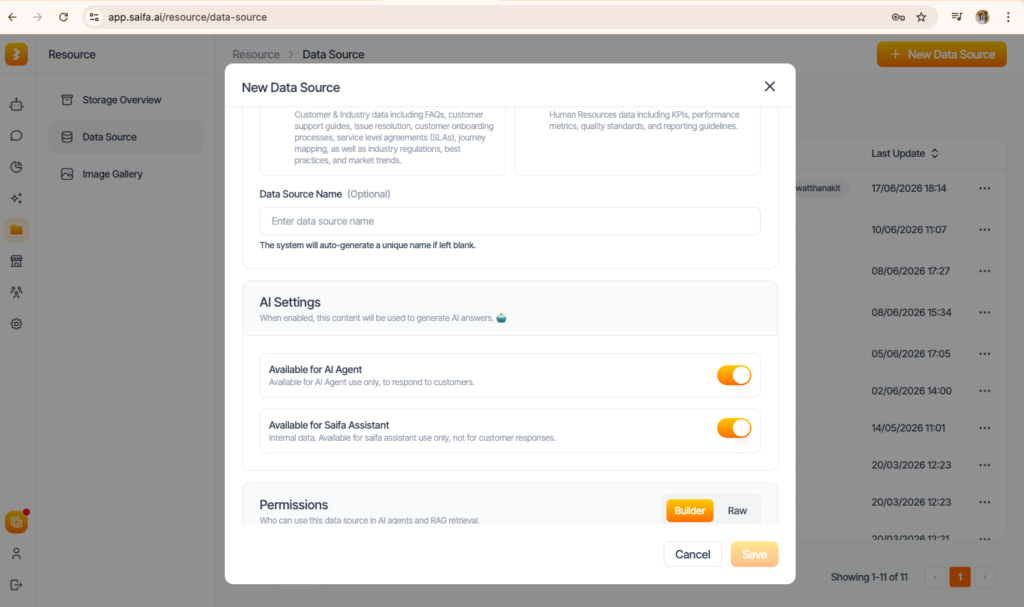
Saifa AI enables SMEs with extensive information accumulated from various sources to develop a centralized company Knowledge Base to facilitate employees’ access to crucial information.
It could be SOPs, operational processes, product information, company policies or internal documents, but whatever employees ask AI, it will be answered based on the company’s own data.
So, this helps save time looking for information, improve internal communication and create more consistent workflows between teams.
Step 3: Create an AI Workspace to Boost Team Productivity
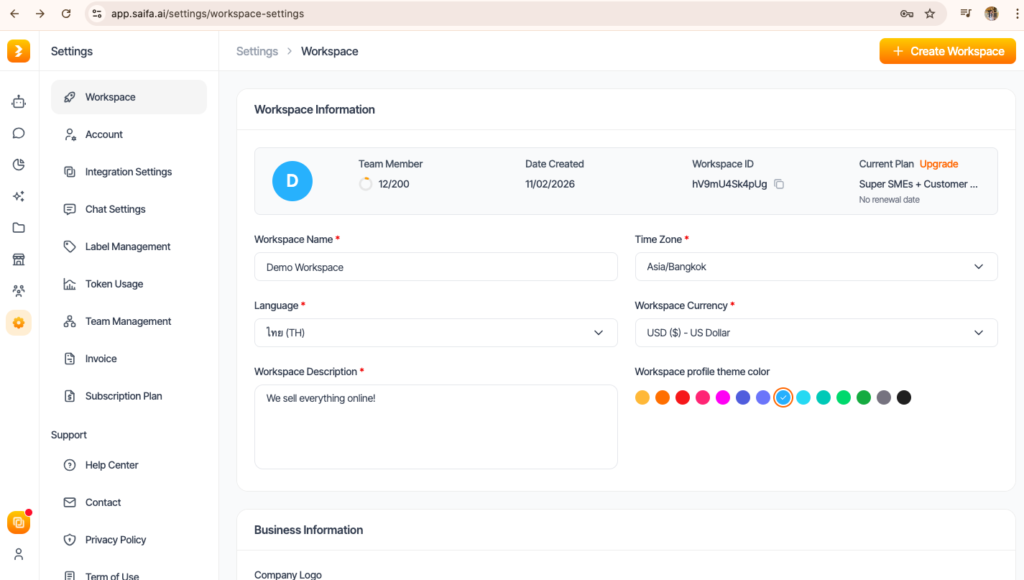
Saifa AI allows employees to use AI as a daily work assistant to boost productivity besides customer support.
AI can be used with teams to analyze conversations, synthesize information, manage customer data and support other business functions.
So, employees spend less time on routine work and more time on strategic work that requires creativity, decision making and business growth.
👉🏻Learn more: What is Saifa AI? A Complete Step-by-Step Guide for Beginners
Summary:
Before making a decision on an AI solution, businesses should consider a number of important factors such as ease of use, integration with existing systems, data security and ability to scale in the future. The best AI tool isn’t the one with the most advanced capabilities, it’s the one teams can successfully adopt and integrate into real business operations.
Another important step is to test AI on a small scale before deploying it throughout the organization. Beginning with simple use cases provides businesses with a better understanding of the benefits, limitations and possible impacts. That means companies can tune their approach before they scale up their use of AI, reducing the risks and getting the most value from their AI investment.
Once the right AI solution is chosen, the next step is to create a structured implementation plan. This means that AI will not just be a transient technology but a long-term part of business operations that will improve efficiency and create sustainable competitive advantages.”
For businesses looking for an AI solution for customer service, internal knowledge management, team productivity, Saifa AI is a good choice for SMEs to start adopting AI and strengthening competitiveness in the AI era.
👉🏻 Try Saifa AI now: https://app.saifa.ai/signin