4-Step Framework for Scaling Up SME Businesses with AI
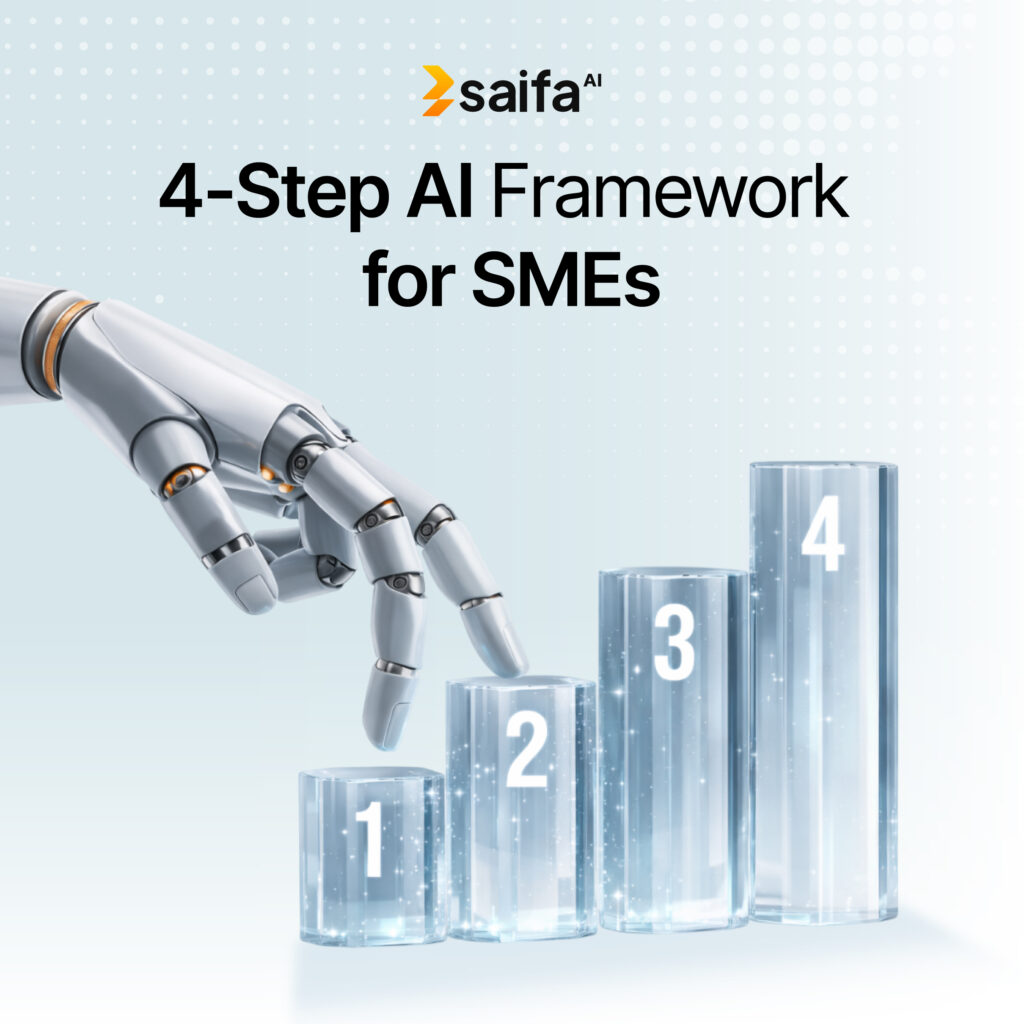
“Where should small businesses begin to use AI?” Right now, small and medium-sized businesses (SMEs) may utilize AI to make their operations more efficient, reduce cost, and scale their business from day one, even before they start working.
First step to expand SME Businesses with AI
A structured AI framework is the first step to effective AI scaling. The process must be done in stages to make the business stronger step by step. A lot of SMEs are starting to use AI, but some business owners haven’t seen any real benefits yet because they don’t know where to begin. To use AI on a bigger scale, business owners need to plan and carry out the steps needed to make AI into a part of work, including people, systems, products, and services.
The most important thing for small business owners is not to ask, “Which AI is the best?” If you’re a business owner and not sure where to start with AI or feel worried about how to use it, the four stages of AI adoption for SMEs can help you understand how AI should fit into your business at each level of growth. And how can we make sure that businesses get meaningful results from investing in AI?
Framework: 4 Steps to Start Using AI to Scale Up SMEs
Step 1: Building AI understanding within teams
Why should SMEs spend money on training your employees? A survey from EY says that smart use of AI in the workplace, along with training employees and rethinking job roles, may boost team productivity by about 14%. To use AI effectively, business owners need to start with the “people” in the business as well as the tools. Employees should get basic AI training that teaches them basic prompts and shows them how to use AI effectively.
The best way for small and medium-sized businesses (SMEs) to start using AI is to get their teams to see AI as a “helper” that makes their work easier and can be used right away without needing any IT experience. This allows employees to focus on higher-value tasks such as strategy, customer relationships, and product development.
Simple examples
- Marketing teams use AI to generate content ideas and plan campaigns
- Sales teams use AI to summarize customer data before making decisions
- Admin teams use AI to manage documents and routine data tasks
Step 2: Reducing costs through automation
The next step is to use AI to do repetitive tasks, like answering the same questions from customers, writing reports, and putting together data and papers. Many small and medium-sized businesses can finish their work faster, spend less money, and have more time to do work that is more useful. AI also helps companies make fewer mistakes and do their jobs more accurately, which raises the quality of all work.
According to research from McKinsey, businesses that use AI and automation for everyday operations can cut down on work time that doesn’t add value by more than 30% and make employees far more productive. This is a big chance for SMEs to get more done without having to hire more staff or spend more on human resources.
Simple examples
- AI chatbots reduce customer support response time from hours to seconds
- Predictive analytics help retailers identify trending products and optimize inventory
- Automated market analysis tools forecast sales trends in advance
Step 3: Enhancing decisions with data-driven insights
After employees or teams learn the foundations of AI, the next step is to “upgrade” how they use it. This includes making decisions based on data, making products or services better, and changing sales methods based on how customers act. According to research, AI can assist business owners make decisions that are up to 25% more accurate by using data that AI has processed that we might not have been able to see otherwise.
Simple examples
- Forecasting sales before ordering inventory
- Identifying which customers are likely to churn
- Adjusting marketing spend based on real-time performance
- Spotting which products are gaining traction
At this stage, AI becomes more like a decision partner than just a tool.
Step 4: Developing AI-enhanced products and services
Small and medium-sized businesses can use AI in their goods without having to start from zero with complicated technologies or AI programs.
Putting AI into products and services will help SMEs better meet customer needs by doing things like making them easier to understand and faster to choose. Small businesses can also start by using AI to improve things they already do, like systems that make suggestions for products, summarize customer data, or make first suggestions on their own. And they won’t have to pay a lot of money up front. It will be more tailored to their needs, and they won’t have to pay a lot of money up front. When AI really makes products and services better, this is the start of AI-driven products that stand out and help businesses grow in a way that lasts.
Simple examples
- Personalized product recommendation systems
- Platforms that learn from real user behavior
- Applications that use AI to assist or automate user decisions
A common mistake SMEs make is choosing AI because others businesses are using it, or buying expensive tools without knowing what to do with them. To answer the question of where SMEs start adopting AI, the most important thing is to start with the “problem” not just “studying AI.”
For SMEs, building a strong foundation is the first step in implementing AI effectively. This includes making sure the team knows how to utilize AI, reducing back-office expenses through automation and AI, improving workflows with data insights, and creating products and services where AI adds value. SMEs may grow methodically and prepare for long-term success when every step is well thought out.
Saifa AI is another shortcut to expanding team capabilities without needing to increase manpower or costs.
👉 Try it for free: https://app.saifa.ai