7 Competitive Disadvantages SMEs Face Without AI
AI is changing the way businesses compete worldwide. Competitive advantages were once driven by such things as capital, size of the company, number of employees and sales channels. But AI is rewriting the rules of competition, providing businesses of all sizes access to technologies that increase efficiency, reduce costs and enable better customer experiences.
AI is becoming a basic capability that businesses in every industry need from online stores and service businesses to large enterprises. And it’s not just a tool to get things done anymore, it’s a technology that helps businesses make faster decisions, better understand their customers, and adapt to evolving markets more effectively.
But as more companies implement AI into their operations, those that have not adopted AI might find themselves more and more behind the curve on speed of operations, labor costs, access to data, and ability to meet customer needs. This change is not about AI replacing people, it’s about how business is moving from time consuming manual processes to working with AI as a partner that empowers the capabilities of the team.
Not using AI may not immediately put a business at a disadvantage. But companies that hang on to However, as competitors leverage AI to improve efficiency, businesses that do the old ways of doing businesses could slowly lose ground in terms of speed, cost-efficiency and customer understanding as competitors use AI.
Overview of the Impact of Not Adopting AI on Businesses
Not adopting AI may not create an immediate disadvantage in the short term. However, as competition becomes more intense, the gap between businesses using AI and those relying on traditional processes will become increasingly visible.
| Business Area | Impact of Not Using AI |
|---|---|
| Operational Efficiency | Spending more time on repetitive tasks such as answering questions, managing data, and creating reports, leaving less time for high-value work. |
| Operating Costs | Requires more manpower and time to handle increasing workloads, resulting in higher costs compared to competitors using AI automation. |
| Customer Service | Slower response times can lead to missed sales opportunities and make it harder to deliver better customer experiences. |
| Data Analysis | Having large amounts of data but being unable to fully transform it into insights, resulting in less understanding of customers and market trends. |
| Business Decision-Making | Relying on manual data collection and analysis slows down strategic decisions in fast-changing markets. |
| Business Expansion | Growth requires adding more employees and resources instead of leveraging AI to support scalability. |
| Competitive Advantage | Falling behind competitors that use AI to build faster, more accurate, and customer-focused business processes. |
The impact of not using AI is not simply about missing out on new technology, but about losing potential business opportunities by continuing to rely on traditional ways of working.
In the future, the difference between fast-growing businesses and those falling behind may not depend on company size, but on the ability to leverage AI to improve efficiency and create competitive advantages.
For SMEs, adopting AI does not require transforming the entire business at once. Businesses can start with areas that create quick results, such as using AI for customer support, data analysis, or internal knowledge management, building a strong foundation for long-term growth.
7 Competitive Disadvantages SMEs Face Without AI
1. Lower Productivity
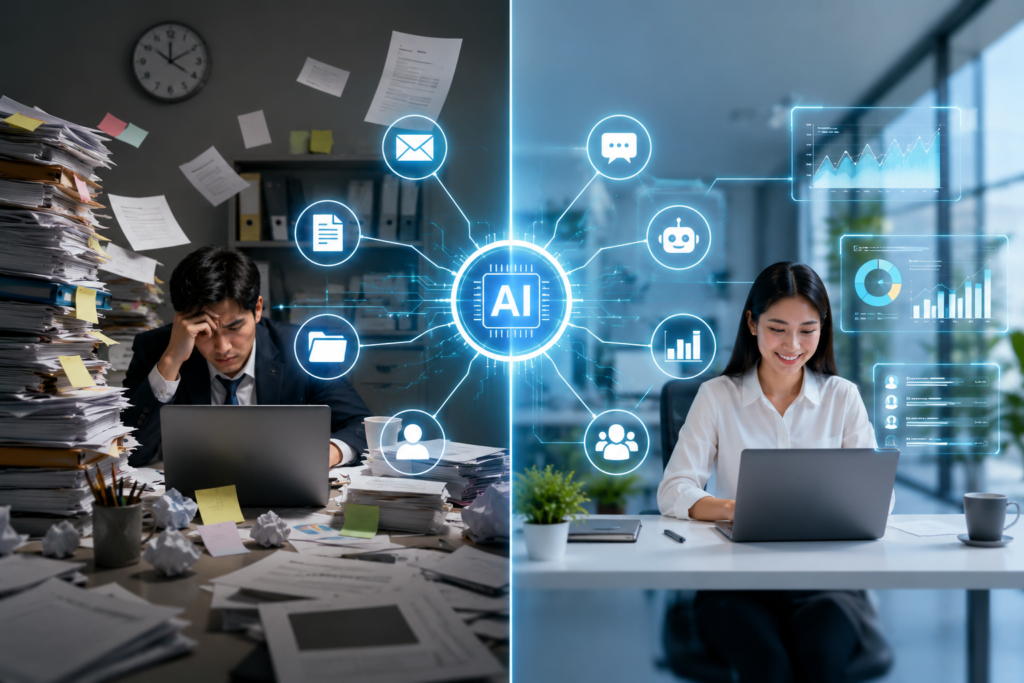
Businesses that still rely on manual processes spend a lot of time on repetitive tasks such as answering customer questions, looking for information, preparing reports and managing documents. These tasks are important but they drain resources from the team without adding direct business value.
This challenge is more visible as workloads increase. Employees spend more time on the routine, and less time on the creative, the strategic planning or building customer relationships.
At the same time, companies that deploy AI may utilize it to perform time-consuming tasks like searching through internal documents, summarizing customer conversations, creating reports, or answering basic questions. This enables teams to free up capacity and focus on higher-value work.
The difference between businesses that have adopted AI and those that haven’t isn’t simply speed, but how well they use the resources they have. Enterprises that utilize AI can increase team productivity without needing to scale their staff at the same rate, while enterprises that use traditional methods may need more time and money to achieve comparable results.
2. Slower Customer Response
Today, Customer Experience is one of the main factors to the purchasing decision. Speed of response is more than simply providing better service; it directly affects sales opportunities and long-term customer relationships.
This is especially for businesses selling products or services through online channels, including Social Commerce, E-commerce or chat-based platforms. If customers are interested in a product, but they don’t get a response at their time of decision making, they can quickly go to competitors who can answer faster.
InsideSales research found that responding to leads within 5 minutes increased a chance of connecting with potential customers compared to responding after 30 minutes later. This means that speed is now a big competitive factor in sales.
Businesses that adopt AI are not only faster responding but they can offer more consistent customer experiences, better understand customer needs and increase the opportunity of closing sales.
At the same time, not adopting AI could mean missing out on key opportunities just before customers make buying decisions.
3. Higher Labor Costs
As businesses scale, workload and operational complexity increase. Many businesses solve this by hiring more employees to handle additional responsibilities. For example growing Customer Service teams, administrative staff to manage documents or expanding operations teams. Although increasing headcount can support short-term growth, it can also become a permanent hidden cost in the long term (salaries, training costs, management time). When the business grows, it becomes more difficult to control costs and still be efficient.
Businesses that adopt AI can improve the capabilities of existing teams and get more work done without increasing resources at the same rate.
AI is also a big opportunity for small and medium-sized enterprises with smaller teams and limited budgets to compete with larger businesses. It helps smaller teams achieve similar productivity as larger companies, and helps them grow sustainably over time.
4. Less Customer Insight
Today, customer data is one of the most valuable assets for businesses. This includes purchase history, customer behaviour, web activity, conversations across multiple channels and post-purchase feedback. These insights help business owners understand customers and create more effective marketing strategies.
But many businesses don’t struggle because they don’t have the data. The challenge is that they have a lot of data but can’t really leverage it to the fullest because the information is spread across multiple systems such as CRM platforms, social media channels, customer chats and internal company files. Traditional ways of collecting and analyzing data are often time-consuming, which means organizations are missing out on valuable opportunities to gain insights.
In the past without AI, business owners relied on old reports or the experience of their team to make decisions. Manual analysis of large and complex customer data sets can prevent businesses from uncovering hidden patterns, but the human experience is still important.
On the other side, AI-powered businesses can shift through large data sets at a faster rate and create valuable Customer Insights more efficiently.
5. Slower Decision-Making
For SMEs it’s not enough to have a lot of data. Businesses need to be able to use that data fast to make better decisions. In highly competitive markets, businesses that spot opportunities sooner tend to get a head start. Now we decide on information not only by experience but also by how quickly we can get and use that information.
Business used to rely on traditional processes like collecting information from various teams, generating Excel reports, analyzing past sales data, or meetings to put together situations. These processes might take days or even weeks before businesses had a complete view of performance.
While these methods still have their place, change is happening at a faster pace than ever in customer behavior and market conditions. Slow decision-making can lead to missed opportunities for businesses, for example, not changing promotions in time, slow reaction to customer problems or not reacting to market changes before competitors.
AI-enabled businesses can crunch vast quantities of data and key insights in a flash, allowing management teams to get a sense of business performance closer to real-time conditions.
6. Weaker Customer Experience
For SMEs, creating a great Customer Experience can be difficult due to limitations in employees and resources. AI helps to overcome these limitations and allows smaller teams to serve more customers while keeping a consistent service quality.
The competition among businesses is no longer only on the basis of product quality today. It also depends on the whole customer journey from awareness to purchase decisions to after sales service.
Companies without AI support may run into challenges like: Longer customer wait times Contradictory information given to customers Restricted access to customer history and conversation data These issues can result in inconsistent experiences depending on the team’s availability and workload.
Meanwhile companies that are using AI Customer Service can offer a more frictionless customer experience. AI is able to answer FAQs, recommend products, send out promotions, respond to simple requests and pass along important messages to sales or customer service teams.
According to Salesforce’s State of the Connected Customer, 88% of customers say a company’s experience is important as products and services.
7. Falling Behind Competitors
One of the biggest misunderstandings in AI is that a business can wait for the technology to fully develop before adopting. But please note that AI isn’t a tool that you can buy and immediately get results with. “It takes time to integrate AI into existing workflows as businesses learn and adapt.”
Today, early AI adopters aren’t just getting faster operations. Through real use they develop data, improve processes, and better understand customers, gaining long-term competitive advantages.
Businesses that delay implementing AI may have to start from day one when AI is a standard business practice. Working effectively with AI will require preparing data, building internal knowledge systems and redesigning workflows.
This is a similar situation to previous technology changes such as E-commerce and Digital Marketing. Companies that moved fast had the opportunity to experiment, learn and build advantages later adopters had to spend more time and resources just to get up to speed.
For SMEs today, getting started with AI can actually be an advantage over larger companies because they don’t have to overhaul complex systems. Smaller companies can experiment, tweak and roll out AI more quickly, so they can deliver concrete results in less time.
Businesses Using AI vs. Businesses Not Using AI
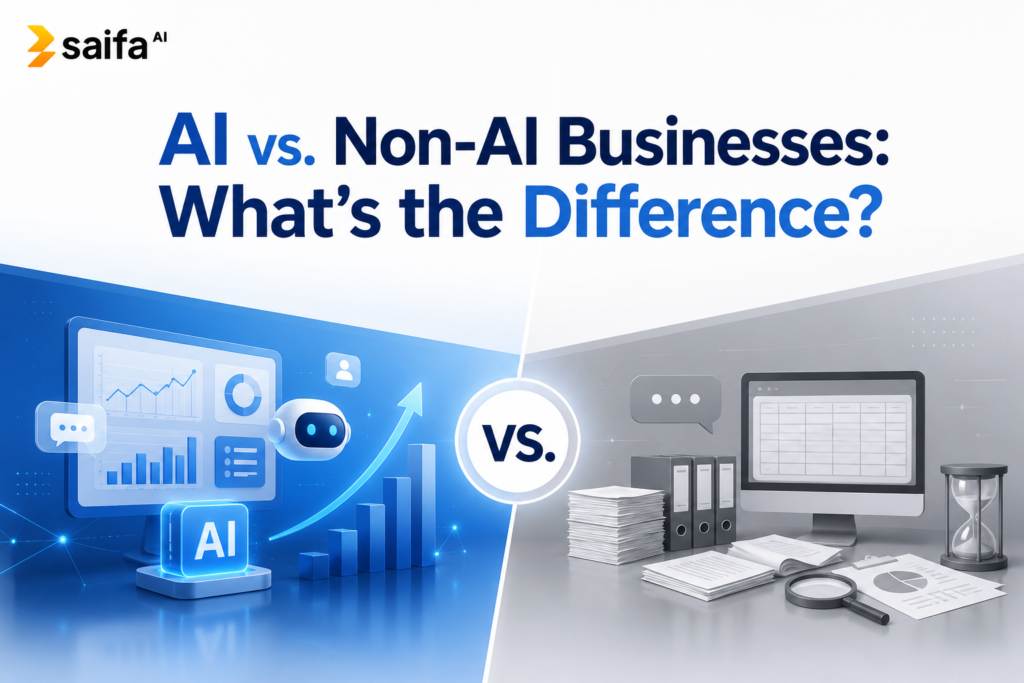
Adopting AI doesn’t mean replacing your entire business system at once. Instead, it enhances your team’s ability to work faster, make better use of data, and deliver better customer experiences.
| Business Function | Businesses Without AI | Businesses Using AI |
|---|---|---|
| Customer Service | Customers must wait for human responses, which may take hours or even days, especially during peak periods. | AI provides 24/7 customer support and can handle multiple conversations simultaneously. |
| Sales | Sales teams manually search for customer information and follow up with leads, increasing the risk of missed opportunities. | AI qualifies leads, analyzes customer interest, and alerts sales teams to follow up with high-potential prospects. |
| Marketing | Customer insights rely on historical reports, making analysis slow and time-consuming. | AI analyzes customer behavior, creates customer segments, and recommends marketing campaign strategies. |
| Data Analysis | Large amounts of data must be collected and analyzed manually using spreadsheets or reports. | AI summarizes data, identifies trends, and turns information into actionable insights instantly. |
| Document Management | Employees manually search files, read documents, and summarize information. | AI quickly searches, summarizes, and answers questions using internal company documents. |
| Team Productivity | Employees spend significant time on repetitive tasks such as writing reports, replying to emails, and organizing data. | AI automation reduces repetitive work, allowing teams to focus on higher-value activities. |
| Knowledge Management | Company knowledge is scattered across files, documents, or individual employees, making it difficult to share. | AI builds a centralized Knowledge Base, enabling every team to access company information instantly. |
Start Using AI Before Your Competitors Get Ahead
There’s no need to build complex systems or make large upfront investments to adopt AI. The secret is finding an AI solution built for real business needs that can evolve as your organization evolves.
Saifa AI is a Company AI platform that allows businesses to build AI assistants trained on their own company knowledge like SOPs, internal documents, knowledge bases and customer conversations. It allows AI to answer questions, find information, summarize reports, and create customer insights based on real data from your company.
Saifa AI is not only a 24/7 AI chatbot but also supports Multi-Agent AI and integrates with business channels like LINE OA, Facebook Messenger, Instagram, websites, and other business systems. This allows Sales, Marketing and Customer Service teams to work from the same source of truth and collaborate more efficiently.
For SMEs seeking to improve productivity, cut operating costs and stay competitive in an era of AI, investing in a Company AI platform today may provide far greater long-term value than waiting until competitors have already forged ahead.
Summary
AI is no longer just a productivity tool. It is becoming a key driver of business competitiveness across all industries. Businesses that embrace artificial intelligence can become more efficient, extract more value from their data, lower costs and provide better customer experiences. But businesses that continue to operate on traditional workflows could find themselves with higher operating costs, slower decision-making and missed business opportunities.
Getting on the AI train isn’t a trend, it’s a way to set your business up for long-term success.
If you’re looking for an AI solution that really understands your business data, Saifa AI provides an easy way to begin using it without a large technology investment. Saifa AI is AI Customer Service and Company AI combined for businesses. It learns your internal documents, business knowledge, SOPs, and customer conversations and helps every team work more efficiently.
Instead of trying to transform your entire organization in one fell swoop, you can start with high-impact use cases, realize quick wins, and gradually incorporate AI into your business as a long-term competitive advantage.
👉 Get started with Saifa AI for free today: https://app.saifa.ai/