What Is an AI Agent and Which Jobs Will It Replace?
The similar problem exists in many organisations where employees spend too much time on repetitive work. Instead than working on major projects, they regularly jump between several systems to get information, replicate the same processes day after day and collaborate across teams.
That is the power of AI Agents that can help to extract information, automate workflows and execute multi-step activities across business systems.
According to the Microsoft Work Trend Index 2025, companies around the world are becoming the age of the Frontier Firm, where AI agents will be working alongside employees as part of routine operations. AI is moving beyond being a productivity tool to becoming a Digital Colleague that is fully involved in how work gets done, from finding information and analysing data to automating corporate operations.
This transition is a new way of working with people and AI working together to increase productivity, speed up decision making and enable organizations to scale more efficiently.
What is an AI Agent?
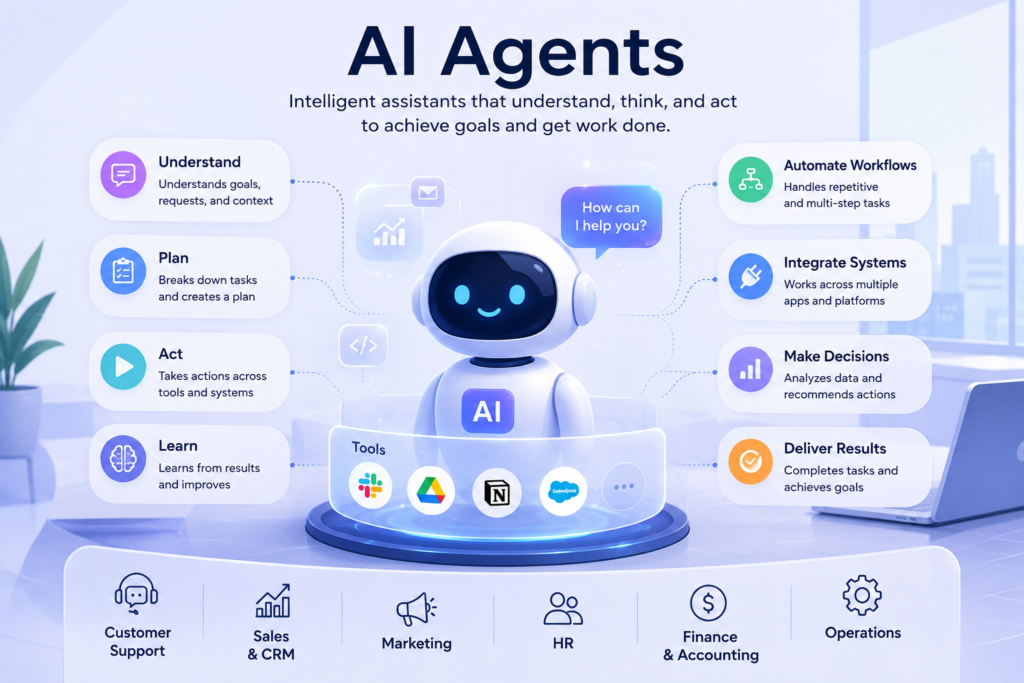
AI Agent is an intelligent assistant that can think, plan and act to complete tasks without human support. AI Agent can do multi-step operations automatically such as gathering information, analysing data, making reports, sending emails, and updating corporate systems, unlike typical AI chatbots that are mainly used to answer questions.
Today AI Agents are used frequently in Customer Service, Company AI, Sales, Marketing and Operations. Among these tools, Company AI is growing more widespread as it allows employees to rapidly access internal knowledge, find answers to questions at work, and spend less time searching for information across multiple platforms.
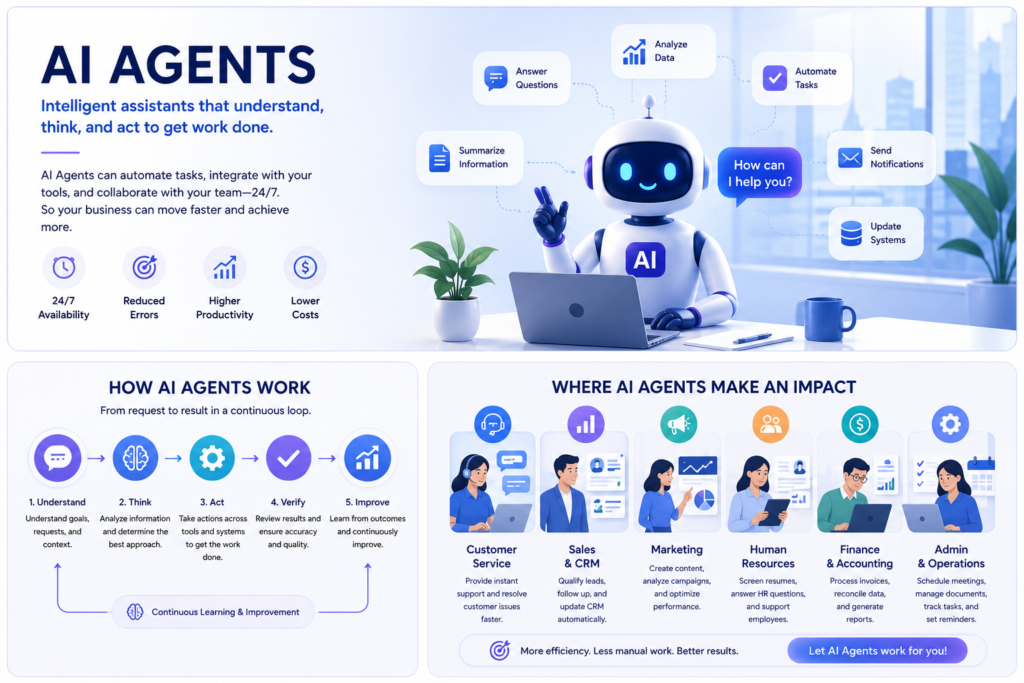
AI Agents Replace Tasks, Not Jobs
There is a common misconception that AI Agents will take over all jobs. AI Agents were created to support some human tasks, not to replace people.
In their day-to-day employees do a lot of repetitive tasks like collecting data, information search, report writing, and performance tracking. These types of tasks can be done by AI Agents, so teams can focus on more important and value-driven work.
As McKinsey AI Agent describes, AI Agents are able to perform multi-step activities in a single system, like planning, data collecting, analysis, and execution. This is the key difference between AI Agents and generic AI chatbots that are mostly focused on answering questions, rather than completing whole tasks.
Where Can AI Agents Help in Team?
1. Customer Service: Respond to Customers 24/7
One of the biggest areas where AI Agents can help the most is Customer Service. Support workers are sometimes faced with repetitious questions every single day like order status, product details, delivery info etc.
AI Agents are trained to perform certain duties automatically like answering FAQs, tracking orders, checking the customer history, recommending products, and forwarding difficult cases to human agents as required.
This helps customer support professionals to work faster and focus on more important or complex customer problems, while AI solves basic questions 24/7.
2. Sales Team: Qualify Leads and Close Deals Faster
Most of a sales team spends more time focusing on administrative work not selling. There are tasks that can be repetitive and time consuming such as qualifying leads, gathering customer information, updating CRM data and following up with potential customers.
AI Agents take on these repetitive tasks, such as gathering customer data, monitoring high-potential leads, managing customer information, and updating CRM systems. So, sales teams may spend more time building relationships, engaging with customers and closing more sales.
3. Marketing Team: Turn Data into Actionable Insights
Data helps marketing teams understand their customers and analyse marketing campaigns effectively. But collecting customer information and analysing data from multiple platforms can be time-consuming.
AI Agents complete this by collecting data , analyzing customer behaviour , segmenting audiences , monitoring campaign performance , and identifying critical metrics like CTR and conversion rate . Instant insights mean marketers can make decisions faster, optimize campaigns and focus on strategy and creative work.
4. HR Team: Simplify Recruitment and Employee Support
AI Agents help HR teams automate routine processes from hiring new talent to supporting existing employees. This administrative work can take up a lot of the HR team’s time.
So AI Agents can help with screening potential candidates, managing applicant information, resolving common employee questions, and providing HR policies and benefits. AI Agents will support manual tasks and let HR teams to focus on recruiting, developing talent, and building a stronger workplace.
5. Accounting Team: Review Financial Documents Faster
Finance and Accounting teams deal with massive volumes of repetitive, data-intensive tasks that have to be accurate. AI Agents can be used to automate operations like invoice verification, expense tracking, matching purchase orders, summary of financials and simple expense analysis.
But human control should be retained in financial approvals and important choices. AI Agents can prepare, validate and analyse the material, and financial leaders can make the final decisions through a human-in-the-loop strategy.
6. Admin & Operations: Automate Routine Tasks
Administrative teams are at the foundation of the routine tasks of every business. But spend a lot of time on repetitive operations that don’t bring a lot of strategic value.
AI Agents can automate processes including setting calendars, managing documents, retrieving files, summarising meetings, tracking tasks, and reminding deadlines. By streamlining these procedures, companies can increase productivity, lower operational costs and allow teams to focus on value-added tasks leading to continuous improvement.
Why Should SMEs Start Using AI Agents Today?
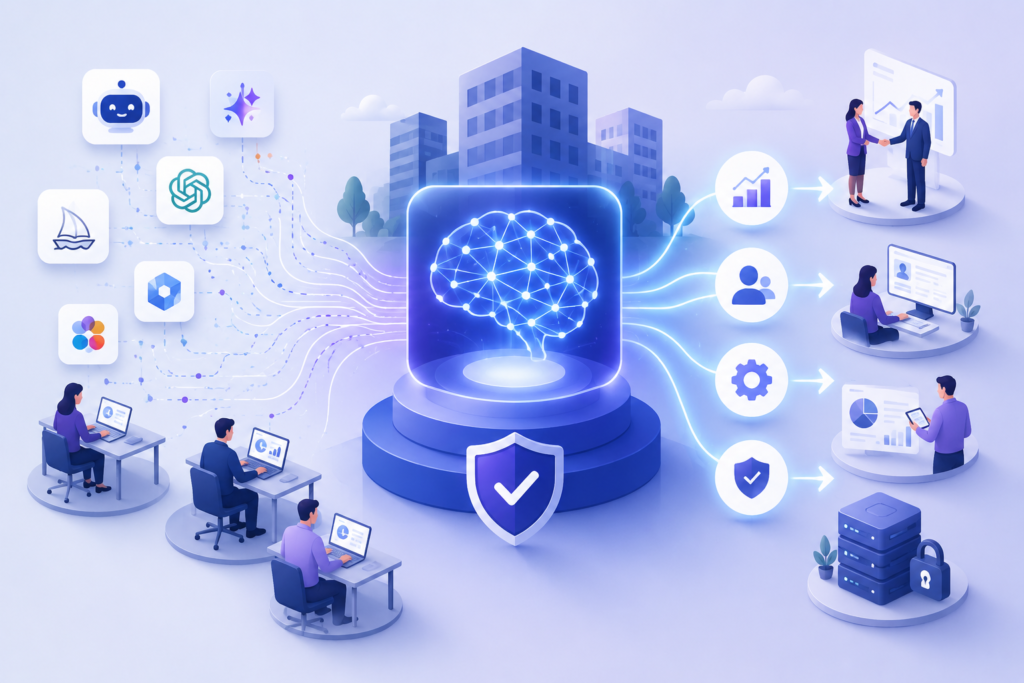
Many large organisations have already embraced AI Agents, but SMEs have the most to benefit if they start using AI Agent earlier. Where once it was an expensive, complicated technology, now it’s more accessible, affordable and easier to apply. Businesses can begin with one use case and evolve with their needs, without a big one-time investment.
Many SMEs have employees who handle multiple tasks. They spend their day on customer calls, processing orders, following up on leads, doing paperwork and writing reports.
AI Agents can execute these repetitive tasks 24/7, cutting down on manual work and reducing human errors. That means teams can spend more time on higher value work like supporting customers, growing business and making strategic decisions.
According to the Capgemini Research Institute, organizations that are early adopters of Generative AI and AI Agents are beginning to see a return on their investments (ROI) within one to three years.
Get Started with Saifa AI
If your business is spending too much time on repetitive tasks such as answering customer inquiries, qualifying leads, tracking work, or searching for internal information now is the right time to implement AI Agents into your workflow.
👉 Start using Saifa AI for free: https://app.saifa.ai/