What Is Company AI? Why Many Businesses Are Starting to Build It
OpenAI Enterprise Report highlights the transition from generic AI use to incorporating AI right into key business operations such as customer assistance, coding, automation and data analysis.
As companies begin to regard AI as a fundamental component of “business infrastructure” similar to CRM or ERP systems of the past many are developing their own internal corporate AI, or “Company AI.” This is particularly the case for organizations which want more control over their data, accuracy and workflows.
In the past, companies may have only employed AI to answer questions or create broad content. However, today many organizations want AI that really understands “business context.” This may be product data, operating manuals, SOPs (Standard Operating Procedures), customer histories or the specialised processes of different teams. This has given rise to the concept of Company AI, which is AI that is specifically created and educated to work with a company’s unique internal processes.
What is “Company AI”?
Company AI is AI that develops, customised, or trained on a company’s own data, systems and workflows. Its goal is to enable organisations to work faster, with more accuracy and alignment to business objectives than generic AI.
Unlike the general AI like ChatGPT or Gemini, which are trained on open source data, Company AI is explicitly related to internal company data. This comprises product information, operational manuals, customer databases, CRM systems, internal paperwork and sales history. So the AI has a deep insight of the “company context” and can do unique jobs with a much higher level of effectiveness.
Many companies today no longer consider AI an optional add-on. Rather, it’s turning to a “Digital Employee” a virtual assistant that’s driving productivity across several departments like Customer Support, Marketing, Sales, HR and Operations.
Major global benchmarks include:
- Boston Consulting Group (BCG): Reported to have deployed over 36,000 internal Custom GPTs to handle specialized tasks across various individual projects.
- Google Cloud & EQT: Partnered to drive AI adoption across EQT’s portfolio of more than 300 companies.
- Tata Consultancy Services (TCS) & Mistral AI: Partnered to build Custom AI Models tailored specifically to enterprise needs.
How is Generic AI different from Company AI?
| Comparison | Generic AI | Company AI |
|---|---|---|
| Data Sources | General internet data and public datasets. | Internal company data such as Knowledge Base, CRM, ERP, SOPs, product catalogs, and company documents. |
| Business Understanding | Understands general information but not company-specific context. | Understands products, customers, workflows, and company policies. |
| Accuracy | Provides broad responses that may not always align with company data. | Uses real internal data, reducing errors and misinformation. |
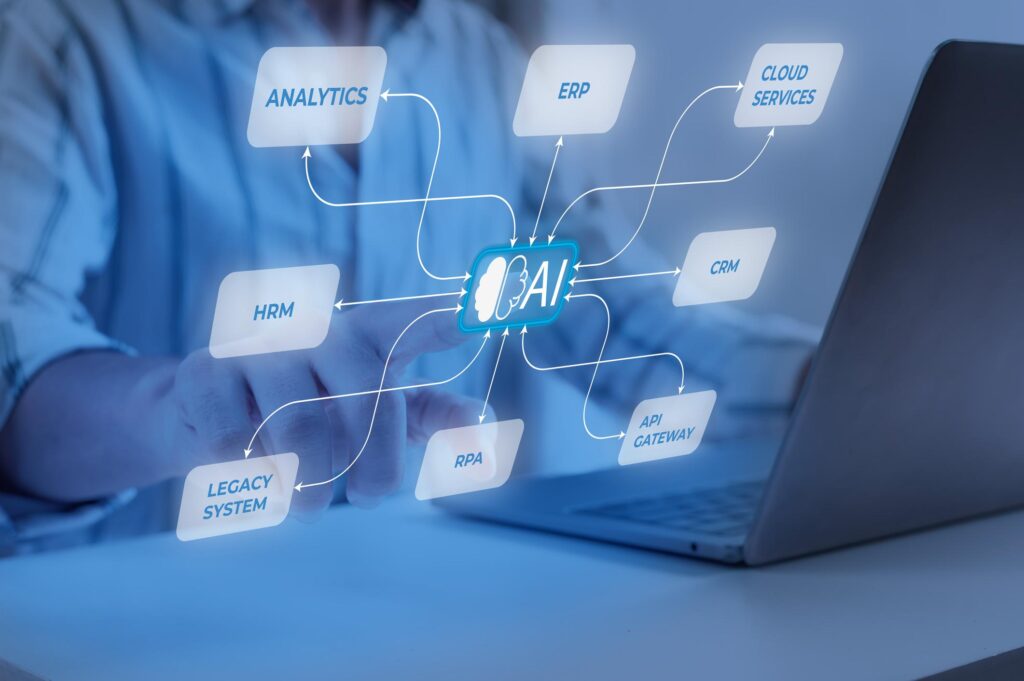
| System Integration | Usually works as a standalone tool. | Can connect with Social Media, Marketplace, CRM, databases, and business workflows. |
| Functionality | Helps answer questions, write content, and generate ideas. | Can execute end-to-end workflows such as creating tickets, checking inventory, generating quotations, updating CRM, and automating tasks. |
| Data Security | Operates on public platforms with limited data control. | Provides full control over data access, storage, and compliance within the organization. |
| Customization | Limited to prompt-level or custom GPT adjustments. | Deep customization with knowledge base, workflows, AI agents, and business logic. |
| Recommended For | Individuals for general use or early-stage AI users. | Solopreneurs, SMEs, Enterprises, or organizations that want AI embedded into core business operations. |
Key Reasons Why Businesses Are Building Their Own "Company AI"
1. Maximizing the Internal Corporate Data
Most organizations have important data across several platforms. Be it customer profiles, purchase histories, operating manuals, internal paperwork, or data from CRM. This data has historically been compartmentalised and under-utilized. As AI capabilities improve, corporations are building Company AI that directly taps those internal sources. This allows the AI to understand the real context of their particular firm, rather than just general data collected from the internet.
2. Data privacy and security
Another important factor of the move to Company AI is data security and regulatory compliance. This is especially true for industries that handle extremely sensitive data, such as finance, healthcare, legal services, and major enterprises.
Public, off-the-shelf AI technologies are convenient but a lot of companies have been concerned that feeding internal data into an external system could risk data hacking or endanger corporate secrets. So organizations are opting to invest in Company AI either by implementing Private AI environments or by leveraging Open-source models on their own infrastructure. The architecture offers clients full control of their data ecosystem, from data storage and access methods to user permissions within the business.
3. Applying AI in Real “Company Workflows”
Increasingly, organizations are coming to understand that AI brings real business value not only through its ability to answer questions but through its ability to seamlessly work with current internal systems.
As a result, many businesses are starting to set up Company AI that connects directly with their CRM, sales platform, inventory management, ticketing solution or customer support system. This allows the AI to do end-to-end operations, such as processing customer orders, checking stock levels, creating financial summaries or automatically sending data to back-office systems. This allows companies to completely cut manual work, remove repetitive tasks and dramatically increase team efficiency.
4. Transforming AI into a “Competitive Advantage”
AI is becoming a technology that every business can use, and the competitive advantage is not who has AI, but who has the AI that best understands its own business. Companies that can leverage their own data to build AI that knows their customers, products and workflows will win on delivering customer experience, have better data accuracy and will be able to make strategic decisions faster.
Data + AI is now seen by so many organizations as a key future business asset. The logic is simple: the better the quality of an organization’s own data, the more advanced and competitively superior its Company AI will be.
5. Long-Term Cost Reduction and Financial Control
Big companies that use a lot of AI are seeing their API fees and token charges go up. As a result, several organisations have started constructing internal AI systems or fine-tuning their own models, to limit cost for the long term.
AI that’s built on third-party APIs or off-the-shelf software-as-a-service (SaaS) platforms is a low barrier to entry, but scaling across a company can send token, API or subscription costs. This is why organisations are moving towards building their own Company AI or implementing open source AI models. This method provides long-term stability in their spending, while allowing them to fine-tune and expand their infrastructure to exactly match the organization’s real workload levels.
6. Shifting AI from a "Tool" to "Infrastructure"
Today, many organisations consider that AI is becoming an essential part of “business infrastructure” like CRM, ERP or Cloud platforms of the past. Enterprises are embedding AI into all operational operations, including Customer Support, Sales, Marketing, Operations and Data Analysis, with increasing frequency.
Company AI is no longer just an assistant that answers questions. It’s becoming the core technology that helps the whole organization work quicker, make better decisions and support long-term business success.
Why “Company AI” is becoming into business
Now big organizations are becoming more aware of that AI value, not just by being good at answering queries, but by integrating seamlessly with internal teams. This means you can connect AI straight to your CRM, sales platform, inventory management or customer support tool to reduce repetitive activities and speed up workflows throughout your whole organization. This has prompted many organisations to imagine an AI-enabled “Digital Employee” working side-by-side with human employees in every area from Sales, Marketing and Customer Support to Operations and Data Analysis.
Most importantly, as AI adoption becomes general, the competitive advantage evolves from “who has AI” to “who has the proprietary data and AI infrastructure that best understands their own business.” This is the change that makes Company AI a significant competitive advantage and is why companies are investing thoroughly to create Company AI today.
If you are looking for an AI that goes beyond a basic chatbot. Saifa AI features a built-in Company AI solution. It is explicitly designed to help organizations deploy practical AI, customized to align with the unique operational processes and specific needs of your business.
👉🏻 Try Company AI now: https://app.saifa.ai/