How to Use AI to Develop Products or Services That Sell from Day One
In the past, new product creation frequently started with an initiative or entrepreneurial experience. However, this is changing in the age of AI. AI can look at data more quickly, such as how people act, what’s happening in the market, and input from customers in real time.
AI doesn’t simply “help with thinking”; it also helps “discover” new ideas that business owners might not perceive. This is especially true in markets with a lot of data sources, like social media, marketplaces, or search trends, which are all important for product creation. ScienceDirection’s research shows that AI may boost a company’s ability to come up with new ideas and help them combine “mass production” with “personalization” in a more efficient way. This means that small and medium-sized businesses can now make specialty products without spending a lot of money, like they used to.
Why Should SMEs Use AI to Develop Product and Service Ideas?
Developing a new product or service is certainly not easy and requires time to compete in the market, especially for small businesses with small teams and limited budgets. Focus groups, hiring consultants, or conducting in-depth market research can take months to develop a product and can be expensive. So why should business owners turn to AI for product and service development?
- AI processes large amounts of data faster and more thoroughly. Especially when analyzing customer behavior, market trends, or data from multiple sources simultaneously.
- AI can spot “small signals” that humans might overlook. AI models, such as machine learning, can detect signals of changing customer behavior, allowing businesses to know in advance what customers are interested in or are losing interest in.
- AI accelerates the idea generation process. Instead of starting from scratch, AI can help “build upon existing resources” or “present differentiated ideas” with high market potential.
- AI enables more accurate strategic decision-making. With the insightful data analyzed by AI, businesses can make decisions based on “real data” instead of guesswork based on market conditions and develop strategies that align with customer behavior.
- Opens up opportunities to discover “new markets.”
- By analyzing customer behavior and hidden needs, businesses can see target groups or opportunities that have never been considered before. And they can create products and services before their competitors.
Numerous studies indicate that combining AI with human decision-making is more likely to be successful than relying solely on human or AI decision-making (for example, research from the Harvard Business Review found that organizations integrating AI into business decision-making achieved higher sales and innovation). Furthermore, a report by the McKinsey Global Institute states that AI can help increase product development processes by 20–30% and reduce time-to-market.
How to Use AI to Create New Products and Services in Business That “Click with Customers” From Day One
1. Start with “Looking for Opportunities”
One of the most common mistakes business owners make is starting with an idea they “like” instead of “what the market needs.” This often leads to their products never reaching the market.
AI can help gather information about needs from the start. Business owners can use AI to extract market or customer demand data before starting, such as Google Trends, Social Listening, and Marketplace Data. This data can then be analyzed to identify growing needs, such as trending products, products that are being talked about more, or recurring customer pain points. This allows business owners to see “gaps in the market” that haven’t been filled yet, and transform this into actionable insights immediately.
2. Using AI as a “Co-creator” to Generate Product Ideas
One of the problems for business owners is that we frequently become caught in old patterns of thinking. But AI can help you see things in a new way. We can use AI as a co-creator to come up with new product ideas instead of just thinking about them on our own. For example, we might build on existing products or combine concepts from different industries. Once you see an opportunity, the next step is to leverage AI as a “thinking partner” to make the concept bigger and better.
What’s interesting is that AI doesn’t just think like a human; it helps pull data from real trends and behaviors, resulting in ideas that are “more feasible in the market.” This reduces brainstorming time and gives us more options before deciding to develop them into actual products.
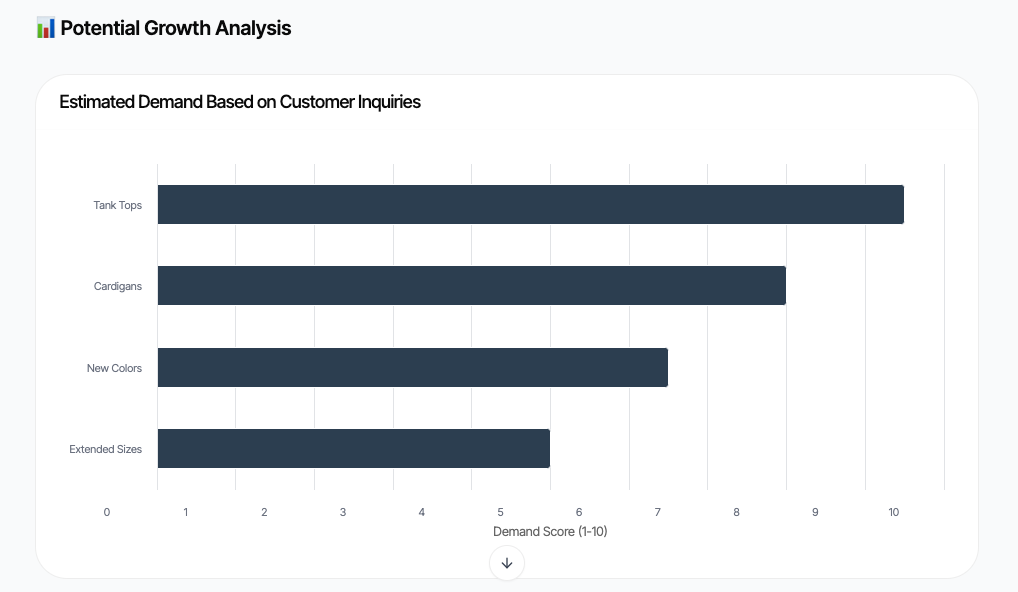
Below is an example of using Saifa AI to help find potential growth.
3. Turning Insights into Products (Product Development)
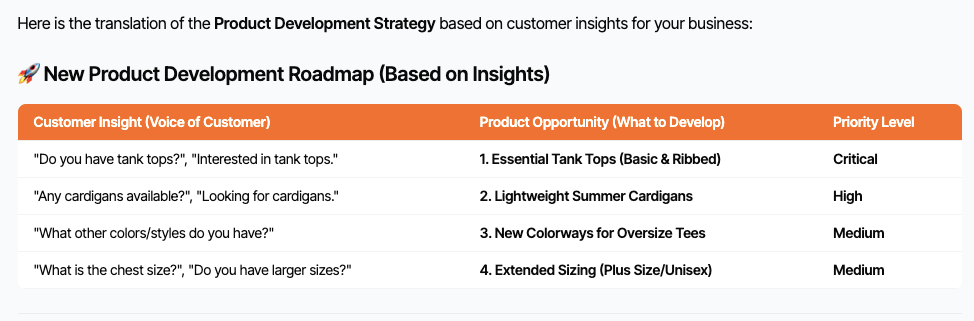
The next step after coming up with an idea is to turn it into a real product. AI can help with this process, from coming up with the idea to making the product’s smaller parts.
When it comes to figuring out the product’s value proposition, where it fits in the market, or even who the best target group is, AI can help turn ideas into more clear pictures. AI can help you “organize your thoughts” and turn them into a product framework in a planned way.
4. Test Your Ideas Before Investing
One of the biggest risks for SMEs is putting money into things they “think are good” but the market doesn’t need. AI helps reduce this risk by looking at how likely it is that a product will sell, what price it should be, or what kind of marketing should be employed to talk about it. Before making a product, AI can be used to simulate various scenarios before deciding to produce the product, or even to create mock content to test with customers through advertising campaigns.
5. Create Personalized Products to Increase Value
One of the most key point is customers don’t only desire “good products,” they want “products that fit them.”
AI makes it easier for companies to build products that are just right for each customer. For example, AI can suggest things that are just right for each person, change designs to fit their tastes, or even let customers help design the product. This not only boosts sales, but it also adds “value” to the product because customers feel that it was made just for them. For firms that want to stand out, customisation might go so far as to let customers “participate” in the product.
6. Expanding from “Products” to “Services”
Successful businesses don’t just sell products, but sell “experiences” and “services” together. AI insights don’t just tell you what customers buy, but also what they want after the purchase. For example, they might need usage advice, initial consultation, or additional after-sales service. These are opportunities to “expand services” that many businesses overlook.
The more a business can connect its products and services, the stronger the long-term relationship with its customers can be. This represents a shift in the business’s role from “seller of products” to “customer experience provider,” where AI plays a crucial role in connecting all these points. When products and services are integrated, the customer experience doesn’t end with the “purchase” but becomes a “long-term relationship” with continuous interaction.
Caution: AI Can Make Mistake
When using AI to produce new products, business owners should be careful about how accurate their data is and how likely it is that someone would steal their ideas. AI might come up with concepts or designs that are the same as ones that currently exist, which could be against the law. Also, the technical feasibility and real business necessity should be looked at, since AI might come up with excellent ideas that aren’t marketable. Finally, when you use AI to look at data, you need to consider about the privacy and safety of your consumers to decrease legal risks and preserve their trust.
In the end, businesses who can utilize AI to fully connect information about products, services, and experiences will not only be “great for sales,” but they will also become brands that people “really engage” with and choose to stick with for a long time. This is a very crucial base for the long term.