The Impact of AI on Job Layoffs in 2026
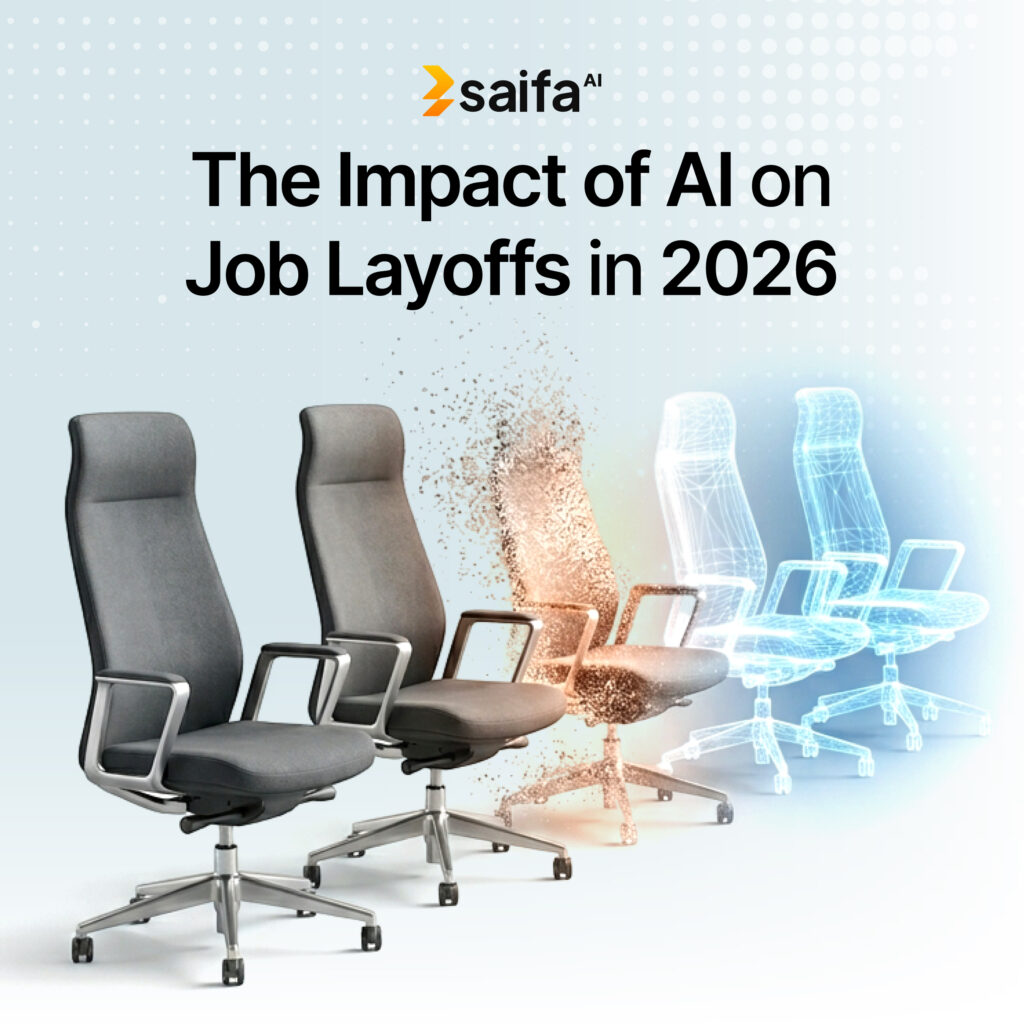
We are currently at a significant inflection point in the labor market due to AI. The most noticeable signs are the rapid decrease in job openings and layoffs at many big companies such as Amazon, JPMorgan, Walmart, and Wells Fargo. While AI was initially seen as a tool for increasing efficiency and profit, its impact is now becoming more widespread.
By 2026, AI technology will have moved beyond to structure transforming employment across many industries globally. Investment in AI continues to increase, but hiring employment in some sectors is slowing down. This trend reflects not only “cost reduction” but also a restructuring of organizations to align with the new digital economy.
What sectors of the workforce are impacted by AI?
- Tech & Software Industry: AI has a profound impact on the technology sector. Many big companies, such as Microsoft, Amazon, Meta, Google, and Salesforce, have announced layoffs of thousands of employees by 2026. They have justified this decision by citing organizational restructuring and investments in AI and advanced models. This is partially attributable to the elimination of positions that are not consistent with the new direction.
- Finance & Business Services: Economic media reports suggest that the finance, insurance, and white-collar business services sectors are experiencing a decrease in hiring and are likely to experience some cutbacks. This is due to the fact that these are positions that are being gradually replaced by AI or automation, including document processing, reporting, and fundamental data analysis. Certain positions are experiencing substantial reductions in their responsibilities.
- Logistics & Transportation: The logistics and transportation sector is rapidly integrating AI and automation into warehouses and supply chains, particularly in large transportation companies that are restructuring to reduce costs. This has led to a decrease in the amount of repetitive operational tasks, such as warehouse and picking staff, and an increase in the demand for workers with expertise in technology maintenance, data analysis, and system control.
- Retail & Customer Services: The retail and customer service sector is also being affected by AI in various ways, with a particular emphasis on the adoption of chatbots, automated checkout systems, AI-powered customer inquiry systems, and automated online services to supplant basic service tasks. This has led to the replacement or merger of certain general service personnel within organizations.
- Human Resources & Admin: Reports from a variety of employment analysis platforms suggest that large organizations are beginning to decrease the number of operational-level HR personnel and are utilizing automation or AI to replace them in the initial stages of recruitment, including resume screening, interview scheduling, applicant assessment, and internal paperwork. HR is transitioning to a strategic partner function that is responsible for the long-term development of employee skills and the maintenance of organizational culture.
Key Findings: The Impact of AI on Layoffs in 2026
1. Reducing the Role of Repetitive Tasks
McKinsey & Company study shows that routine, repetitive tasks are likely to be taken over by AI and automation. This trend fits with that research. This is particularly true for jobs like operational clerical work, data entry clerks, and entry-level customer service that involve entering data, processing documents, checking data, and making simple reports. It is expected that these job groups will continue to lose jobs between 2025 and 2027, as companies put more money into AI to cut costs and speed up work.
Not only is there a “reduction in workforce,” but repetitive tasks are becoming less important. Instead, people are focusing on tasks that need analysis, strategic decision-making, and AI control. Many companies are moving people who used to process data to jobs that involve checking the quality of the data, making sure it is correct, or doing more in-depth analysis.
2. Tech Companies are Building AI While Reducing employee
While many IT businesses are reducing their workforces, they are also investing more in machine learning and AI technology. This indicates an ability toward “skill restructuring,” or moving from general tasks to those directly relevant to AI, rather than a contraction of businesses.
Therefore, this isn’t a decline in the tech industry, but a “business shift” towards a full AI era. Teams that previously developed traditional features may be reduced in role, while the demand for Machine Learning Engineers, AI Researchers, Data Engineers, and AI Product Managers continues to rise. Data from several labor reports indicates that employment in AI-related positions is growing, contrary to the reduction in general positions. This reflects that companies don’t need “fewer people,” but rather “more different skills” a restructuring of human capital to align with new business models driven by data and AI.
3. White-collar jobs are beginning to be impacted
This shift represents a significant shift in the AI-driven labor economy. In the past, jobs requiring physical labor, such factory or production line work, were typically most affected by industrial revolutions. White-collar jobs that were previously viewed as “safer” would begin to experience increasing pressure by 2026, particularly those that require handling large amounts of data, producing reports, examining papers, or adhering to strict regulations.
However, not all white-collar jobs are equally at risk. Jobs requiring strategic decision-making, deep contextual understanding, creativity, or communication, such as business consultants, marketing strategists, or senior executives, remain crucial because AI lacks the deep understanding of emotions, language, and social context.
4. New position occur alongside with layoffs
While some positions are being cut, the demand for new skills such as Data Analysts, AI Engineers, Automation Specialists, and AI System Administrators is increasing. This reflects that the demand for labor hasn’t disappeared, but rather a shift towards “skills that the market needs.”
But at the same time, organizations continuously need more personnel who can design, maintain, and develop AI systems. From an organizational perspective, this represents a shift in budget from operational labor costs to investment in personnel who can directly create a technological advantage, such as building customer behavior analysis models, developing internal automation, or creating AI systems that increase revenue.
5. Businesses that adapt to AI will have a competitive advantage.
Businesses that strategically adopt AI can reduce labor costs, increase service speed, and scale without increasing the number of employees. This creates a gap between companies that use AI and those that don’t. In the long term, what’s happening isn’t just a cost difference, but a “speed gap.” Companies that use AI can experiment with marketing campaigns more, analyze customer data more deeply, and adjust strategies faster, leading to exponentially faster organizational learning. Meanwhile, companies that don’t use AI may take longer to see the same picture.
This difference will become evident in 2026, when organizations that strategically use AI will be able to work faster, at lower costs, and make more accurate data-driven decisions than competitors still using traditional processes. For example, sales reporting, customer behavior analysis, stock forecasting, or answering basic customer questions can be automated 24/7 without increasing costs.
Businesses that adopt AI often see clearer cost and revenue results than those still in the experimental stage. This means that AI is not just a tool to increase convenience, but a catalyst for business productivity.
6. Humans shift from “operators” to “system administrators.”
In many industries, employees are not being completely replaced by AI, but it is making their jobs more important. For example, accountants who used to spend most of their time entering data may now focus on analyzing financial statements in more depth and giving business advice. Marketing departments that used to do all of the reporting by hand could now use AI to look at how customers behave and use that information to make more accurate plans. This would mean moving from “doing everything by hand” to “using systems to their fullest potential.”
This means that workers need to know how to do things like Critical Thinking, Data Literacy, and AI Literacy. No matter what area they work in, the market is increasingly looking for people who can understand how AI works, set up useful prompts, check the accuracy of results, and figure out the chance of data errors.
7. Big Opportunity for SMEs to use AI
As AI lowers the expenses of running the whole system, the market will compete more and more on “speed and quality,” not just price. Businesses that use AI to analyze customer data in real-time can adjust offers, promotions, or content more quickly, leading to higher customer expectations.
However, the strengths of SMEs and Solopreneurs is agility, rapid decision-making, and uncomplicated organizational structures. This is quite similar to a Lean strategy to employing AI, which starts with small, key tasks like using AI to look at weekly sales, write marketing content, or run automated customer response systems.
Conclusion:
2026 will therefore be one of the most transformative years in the history of the digital workforce. AI is becoming the new infrastructure of the economy, much like the advent of the internet in the early 2000s. Those who understand this structural change first will have the opportunity to design new business models first, and that may be the most significant advantage in an era where AI is not just a tool, but a “catalyst for change” in the entire global workforce.
AI is not designed to replace human strategic decision-making, but to function as an “efficiency accelerator.” Expecting AI to do everything on its own without verification could lead to quality of work, data errors, or damage to brand image. Research from MIT indicates that the organizations that use AI most effectively are those that appropriately integrate human and AI collaboration, not complete replacement.
Are you ready to use AI in your business?
See how AI can help your business work better and grow faster with Saifa.AI.
👉 Try Saifa AI now: https://app.saifa.ai